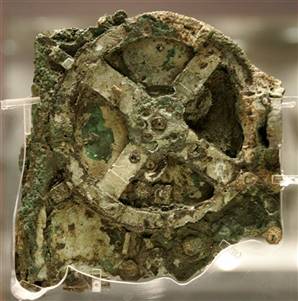
Work has continued on the
Antikythera Mechanism, discovered off the coast of Antikythera at the beginning of the last century; an earlier post
is here. It's been termed, as Wikipedia notes, the world's "first known mechanical computer."
From
Science Daily:
The calculator was able to follow the movements of the moon and the sun through the Zodiac, predict eclipses and even recreate the irregular orbit of the moon. The team believe it may also have predicted the positions of the planets. The findings suggest that Greek technology was far more advanced than previously thought. No other civilisation is known to have created anything as complicated for another thousand years.
Professor [Mike] Edmunds [of the School of Physics and Astronomy, Cardiff University] said: "This device is just extraordinary, the only thing of its kind. The design is beautiful, the astronomy is exactly right. The way the mechanics are designed just makes your jaw drop."
The Wikipedia article on the device has been updated as of yesterday, and is remarkably thorough in its account of its internal systems. Speculation about the uses of the device so far focuses on its astrological and astronomical capabilities:
- Astrology was commonly practiced in the ancient world. In order to create an astrological chart, the configuration of the heavens at a particular point of time is needed. It can be very difficult and time-consuming to work this out by hand, and a mechanism such as this would have made an astrologer's work much easier.
- Setting the dates of religious festivals connected with astronomical events.
- Adjusting calendars, which were based on lunar cycles as well as the solar year.
The NY Times also covered the recent work deciphering the device,
here.
So much we don't know about the ancient world.
~~~~~~~~~~~~~~~~~~~~~~
Photo via the Times from the Antikythera Research Project.Labels: Antikythera, astrology, Further Studies, mind, technology