Wednesday, June 26, 2019

The Sound of Flutes ...

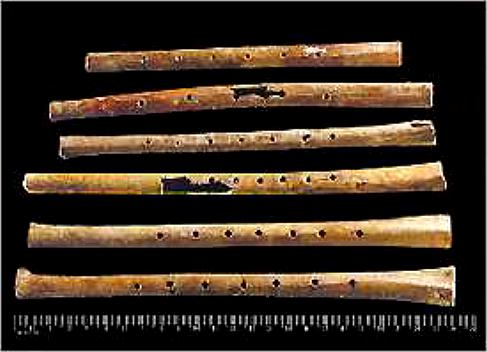
...does go way back, as I began to discover (with the rest of the world) over a decade ago. Live Science posted an article in May of 2012 citing the discovery of several 40,000-year-old bone flutes from the Swabian cave system in southern Germany; this discovery is not even controversial, given that those who crafted the flutes were likely early modern humans, rather than Neanderthals. Music has been with us for much longer than 40,000 years, I'm sure; it's a fundamental part of our human journey.

(First post in a long time, yes, and posts may continue to be rare in this era of social media. We'll see!)

Labels: , , ,

Friday, July 16, 2010

Wait, it's too soon ...

says John Hawks, to order those Neanderthal genetic test kits. Dang. He has cogent reasons why.

Labels: , ,

Thursday, January 14, 2010

Neanderthals, too, had a certain style

Another pair of sites in Spain confirms that our Neanderthal cousins were capable of symbolic thought:
Professor João Zilhão and colleagues examined pigment-stained and perforated marine shells, most certainly used as neck pendants, from two Neanderthal-associated sites in the Murcia province of south-east Spain (Cueva de los Aviones and Cueva Antón). The analysis of lumps of red and yellow pigments found alongside suggest they were used in cosmetics. The practice of body ornamentation is widely accepted by archaeologists as conclusive evidence for modern behaviour and symbolic thinking among early modern humans but has not been recognised in Neanderthals – until now.
Previous evidence of Neanderthal practice in the decorative arts had been dismissed as the result of "stratigraphic mixing (which can lead to confusion about the dating of particular artefacts), Neanderthal scavenging of abandoned modern human sites, or Neanderthal imitation without understanding of behaviours observed among contemporary modern human groups." Professor Zilhão believes that the current finds are clear evidence of advanced cognitive abilities among late members of the Neanderthal line.

(Thanks to Archeoblog for the find)

Labels: , ,

Wednesday, July 09, 2008

No flutes at Shanidar


...but the cave there did provide the first evidence that Neanderthals conducted funeral rites; the large concentration of pollens from medicinal plants in one of the burial sites in the cave led paleontologists to conclude that the body had been buried with flowers.

James Gordon, who's apparently working as a photographer with the Army Corps of Engineers in Iraq, where Shanidar is located, has this nice shot of the cave up on his Flikr stream (via John Hawks). Gordon notes that:

Neanderthal habitation going back 60,000-80,000 years have been unearthed is this very large cave in Iraqi Kurdistan. ...
Of all the skeletons found at the cave, it is Shanidar IV which provides the best evidence for Neanderthal burial ritual. The skeleton of an adult male aged between 30-45 years was discovered in 1960 by Ralph Solecki and was positioned so that he was lying on his left side in a partial fetal position. Routine soil samples which were gathered for pollen analysis in an attempt to reconstruct the palaeoclimate and vegetational history of the site from around the body were analysed eight years after its discovery. In two of the soil samples in particular, whole clumps of pollen were discovered in addition to the usual pollen found throughout the site and suggested that entire flowering plants (or at least heads of plants) had entered the grave deposit. Furthermore, a study of the particular flower types suggested that the flowers may have been chosen for their specific medicinal properties. Yarrow, Cornflower, Bachelor’s Button, St. Barnaby’s Thistle, Ragwort or Groundsel, Grape Hyacinth, Joint Pine or Woody Horsetail and Hollyhock were represented in the pollen samples, all of which have long-known curative powers as diuretics, stimulants, astringents as well as anti-inflammatory properties. This led to the idea that the man could possibly have had shamanic powers, perhaps acting as medicine man to the Shanidar Neandertals. However, recent work into the flower burial has suggested that perhaps the pollen was introduced to the burial by animal action as several burrows of a gerbil-like rodent known as a Persian jird were found nearby. The jird is known to store large numbers of seeds and flowers at certain points in their burrows and this argument was used in conjunction with the lack of ritual treatment of the rest of the skeletons in the cave to suggest that the Shanidar IV burial had natural, not cultural origins.
Then again, a region like the Zagros foothills would have several thousand flowering plant species, of which only about 5 or 10% would be medicinal. It is unlikely that Neanderthals collected medicinal plants. But it is even less likely that jirds do.
Indeedy.

He has some more shots up, so go take a look.

~~~~~~~~~~~~~~~~~~~~~~~~~~~~~

Much of Gordon's note is actually taken verbatim from the Wikipedia article on Shanidar, which gives a provides a good account of the site and discusses its significance.

Labels: , , ,

Thursday, September 07, 2006

Ancient Music Indeed


Kevin Drum is a Political Animal, but every now and then posts in areas that are peripheral to the political brouhaha of the day. Yesterday he posted a short article citing a study of the pitch of women's voices in different cultures; turns out that that pitch is more a matter of culture than biology. Here's what he quoted, from Tyler Cowen's original post about the book:
Women in almost every culture speak in deeper voices than Japanese women. American women's voices are lower than Japanese women's, Swedish women's are lower than American's, and Dutch women's are lower than Swedish women's. Vocal difference is one way of expressing social difference, so that in Dutch society, which doesn't differentiate much between its image of the ideal male and the ideal female, there are few differences between male and female voice. The Dutch also find medium and low pitch more attractive than high pitch.
Kevin adds this:

Which goes to show how powerfully culture worms its way into things that are widely assumed to be mostly biological. Most people believe that women have higher pitched voices as a matter of simple physiology, but it ain't so. It's mostly cultural, and anyone who watches old movies can attest to how the ideal of female voice has changed over the past 70 years.

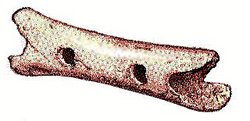
Intriguing stuff. His reference made it seem likely that the post from which he drew it might be worth a read, so I clicked through. Kevin had gotten the heart of it, but one of the commenters on the site had posted a link to another article that he considered relevant, and that article was fascinating indeed, and bears on the deep history of music that I hinted at obliquely last week in my post expressing compassion for Bill Knott, who dislikes music. While I haven't taught anthropology since the early 90s, I do continue to read books and articles on ethnology and paleontology, but I'd missed news of what's become known as the "Neanderthal flute". It's a portion of cave bear femur pierced by two in-line holes, with apparent portions of two other holes at either end of the gnawed bone, also in line with the others. It appears the holes are not evenly spaced, but spaced in the way they would have to be to produce the tones of a diatonic scale. And there's little doubt that it's between 45,000 and 80,000 years old, which would make it by far the oldest musical instrument yet found. It's age would also mean that it was made not by modern homo sapiens, but by the Neanderthal residents of the complex where it was unearthed. That's heresy for many paleontologists, and there've been rivers of ink and bits spilt to debunk the claim, to assert that the holes were made by gnawing wolves, etc., notwithstanding that the odds that accidental, "natural" causes could create such spaced, in-line holes appear to be one in several million. Wikipedia has a good review of the controversy here.

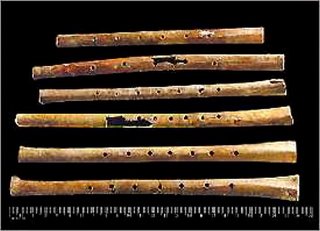
I don't have any special expertise in the area, but wouldn't be surprised if the flute were eventually proved to be genuine, perhaps by the discovery of another of similar antiquity. Notwithstanding the hulking Neanderthal stereotype (a bit of species-based prejudice at work), our Paleolithic kin actually had a fairly sophisticated, if not elegant, tool kit; their Mousterian points, hand axes, and blades are functionally made, and it's certainly within the range of possibility that they could have drilled the femur to make music. But even if it's not a flute, but a fluke of nature, we already know that music pre-dates the use of writing (and all that writing entails, including history) by thousands of years, thanks to the discovery of several flutes, some made from the leg-bones of cranes, in Jiahu, in Henan Province, China, that date to some eleven thousand years before the present.


No one knows exactly why, but the capacity, even need, to make and enjoy music seems built, for some reason, into our biology. So to reject music, it seems to me, is to risk estrangement from a core part of the psyche. Whatever the uses cultures have made of it, whatever the defects of character of those who make it (and I've known some gifted pricks, and prickettes, myself - but, then, poets are not always paragons of virtue or enlightenment either), it seems to me one of the crucial activities that binds us into the rhythms and melodies of the world. As much as I enjoy and admire Bill Knott's work, I'm tempted to deluge him with CDs and tapes until we can find some music that he enjoys. Balian Gamelan, perhaps? Work of Rafe Vaughan Williams, or perhaps the contemporary American composer Eric Ewazen? Messiaen? Or maybe the guitar work of Steve Kimock? At least he probably wouldn't have heard any of it yet in the supermarket.

Of course, my doing that would probably make him more resistant yet to the releases from the cognitive, verbal levels of consciousness that music provides, so I won't. But if Bill should decide to investigate music further, I'd be glad to do what I can to help out.

Labels: , , ,