Tuesday, May 19, 2009

Celebrating Robin Blaser (updated)


On May 7th Robin Blaser, one of the last major figures among those who came to public notice via Don Allen's New American Poetry, passed away in Vancouver, just shy of 84. Though he will forever be associated with Robert Duncan and Jack Spicer as a primary figure in the renaissance of San Francisco poetry in the late forties and early fifties, he also recognized affinities between their work and that of Charles Olson, Robert Creeley, and the other Black Mountain poets. His 1987 lectures on Olson are a rich resource for Olson's poetics, and his own. He and Creeley were friends from the sixties till Creeley's death in 2005. He taught at Simon Fraser University in Vancouver, BC, for many years, and also occasionally at Naropa's Jack Kerouac School of Disembodied Poetics.

(An earlier post on his passing is here.)

I never successfully recorded Robin myself; both times I tried, my usually trusty Uher developed problems. Thankfully, the great Penn Sound audio archive has hours of readings and lectures in his voice, so I put together this week's Wordplay from three of its recordings. The first finds him reading in Vancouver in 1965; the second, discussing his work, and that of his fellows, in a BBC interview with Iain Sinclair from 1994; the third, reading at Milwaukee's Woodland Pattern Bookstore in 2004.

In Vancouver he read "The Moth Poem", an early exploration of serial form; it's a great poem, but the recording, given that it was made on analogue tape over forty years ago (probably by Fred Wah, though he's not credited), had some hiss that I removed for better audibility. In Milwaukee, Blaser began his reading with the introductory section of his extended poem on Dante, then switched to shorter poems, and then returned to the "Great Companions" piece on Dante, saying he hadn't "prepared anything else". I brought the two pieces together for the show. It's a powerful reading.

Music for the show by Bach (the Allegro and Adagio from the Concerto for Violin and Orchestra No. 2 in E Major, performed by the Camerata Romana, conducted by Eugene Duvier); the Kronos Quartet, playing Jimi Hendrix' "Purple Haze"; and Olivier Messiaen, "Praise Eternity" from the Quartet for the End of Time, performed by the Orchestre de l'Opera Bastille, Myung-Whun Chung conductor. The Quartet was one of Robin's favorite pieces of music in the mid-seventies, when I had the good fortune to be at least a peripheral* participant in the continual commotion that was Vancouver poetry scene - at the epicenter of which, I believe most then there would say, stood Robin Blaser.

Enjoy.

~~~~~~~~~~~~~~~~~~~~~~~~~~~~~~
* I actually lived most of the time not in Vancouver, but in Alert Bay, a fishing village a day's journey north. Anyone curious can glean a little of what I was up to from this post from a few years ago.

Uncredited photo from a collection of shots from Blaser's Berkeley years over at the EPC.

Update, 23 May, 2009: And it turns out that this was the last Wordplay - for awhile, at least. See the story here.

Labels: , , ,

Friday, May 18, 2007

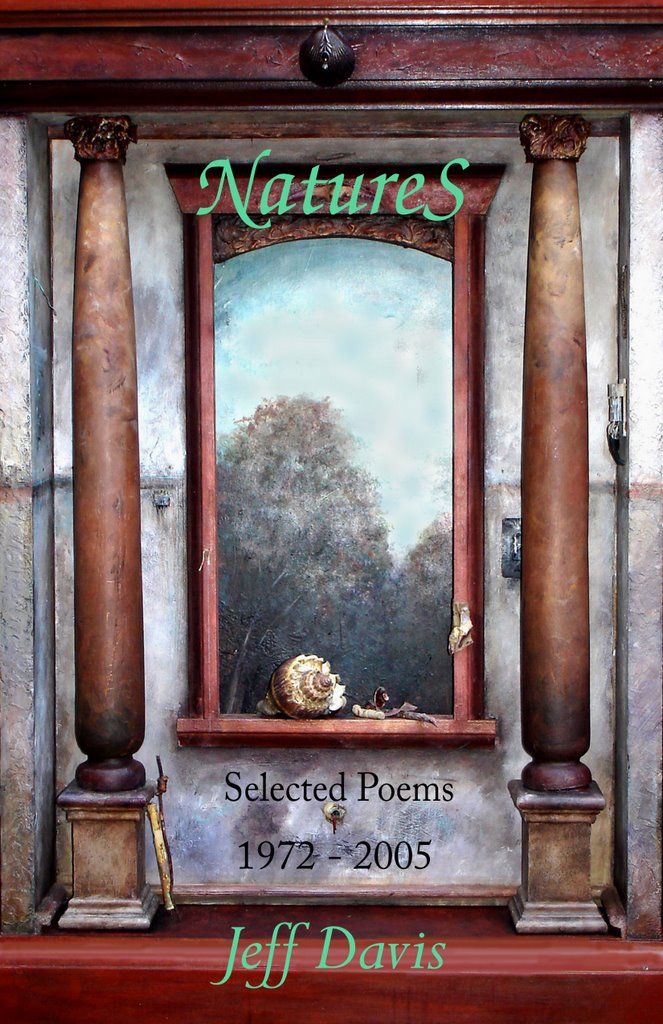
NatureS, a Year Along


So far as I'm aware*, NatureS got about as many reviews as most poetry books do - in this case, one. That one appeared in the Asheville Citizen-Times last October, and was written by Rob Neufeld, who specializes in books exploring local history and folklore. In fact, the review of NatureS followed reviews of a couple other books, one a collection of mountain tales, the other a novel set at Fontana Dam, a resort an hour or so west of Asheville.

Neufeld didn't exactly like the book, and had a couple of condescending things to say about it, but that's all well and good. Here's his take - and this is pretty much the entirety of it (sorry, no link, as it's now behind a paywall):

New Native Press is celebrating the work of Charlotte-now-Asheville poet Jeff Davis with the publication of "Selected Poems 1972-2005." The value of the book is its presentation of a mystical poet's evolution. The early entries are preachy. They expect us to dig the ineffable because, after all, it's ineffable.

Starting with the third of four sections, Davis begins to trust his art. The messages are not substantially different; and the focus on nature remains. But you can enter a beautiful state by forming the words in your mind or mouth.

Hmmm. All publicity is good publicity, I suppose, but at least he could have gotten the actual title of the book right. Oh, well. It was just the Asheville Citizen-Times.

Readers do bring their own heads to the transaction with the text, and I have no wish to over-determine what another pair of eyes, another mind, might find in the poems NatureS carries into the world. But ... (and at the risk of sounding "preachy"), there's a small problem with Neufeld's trope about the "mystical poet's evolution," that being the fundamental one that the poems are not chronologically organized, and therefore don't reveal some sort of linear progress, in good Romantic fashion, of the poet's mind.

It would take delving into boxes of ancient papers to nail it down, but I believe that the earliest poem in NatureS is actually "To the Muse", which doesn't appear until page 34. I still remember well jotting its first lines down on the long ferry ride up the Johnson Straits to Alert Bay, the little fishing village in British Columbia where I lived on and off for most of the early nineteen-seventies. It went through several permutations before it was finished, or abandoned - from an attempt to speak to the nature of a particular love relationship, an attempt that was then reshaped by a Sikh teaching story about (as I remember it, at least) the always nameless Real, eventually to an account of the process of writing as I then understood it.

The poem was substantially finished by 1975. When I was putting the book together in 2004 and 5, a phrase or two reopened, and it changed again, but only by a few words.

It was the first of a number of poems that emerged during the same period, four of which were published in the Vancouver little mag Iron; sometimes, still, I think of them as my "Vancouver poems". That city had then, as I'm sure it must have still, a wonderful community of engaged poets, including the great Robin Blaser, who'd been an integral part of the San Francisco scene that had also included, among others, Jack Spicer and Robert Duncan. The last year I spent in BC, in fact, Blaser published his edition of Spicer's Collected Books, which has yet to be superceded as the standard collection of Spicer's work.** It was a lively scene, with readings almost weekly at The Western Front, Simon Fraser University (where Blaser taught), and various homes and studios around the city.

Blaser had been told by Olson, by Blaser's own account, "I'd trust you anywhere with image, but you've got no syntax," (see "Diary, April 11, 1981", from Blaser's, yes, Syntax), and he'd taken it upon himself, as part of his commission as a poet, to explore strategies for the structure of meaning in language that extended conventional syntax into new territories. His work often structures itself not by explicit syntactic relationship of elements, but by a dynamic parataxis. Looking back, I can see that my own approach to structure and syntax, to the use of fields of meaning opened up by Blaser's work - and that of others, like Daphne Marlatt and Sharon Thesen, working in that time and place - morphed. The poems from Iron represent an intensification of my own experiments with language and form, experiments that seem, to me at least, to have marked a crossing point, a line of demarcation, between earlier work and the poems in NatureS. But, again, this priority is not marked, in any real sense, in the book, and the poems are scattered throughout it, "The Forum in Weeds" at page 22, "The Cotyledon" (in 1975 still untitled) at page 41, "The Bridge" at page 52, and "The Traffic" at page 59.

Indeed, some of the most recent poems actually appear in the first section of the book, including "The Divers", "The Point", "Noetic Issues on the Trail", and "Another Flight", all written within the last few years. Other recent poems scattered through NatureS include "Tithe of Clouds", "Notes in the Common Key", "Toward Pisgah", and "Strata: Melissa" (though it began in the mid-nineteen-eighties as an integral part of "Strata: Rhododendron"). To give Mr. Neufeld his due, the book does close with "Envoi: Another Audition ...", which was in fact the most recent poem included in the book.

So, enough. Or too much. The book can be read in various ways, I'm sure. It's not my purpose to discourage any approaches readers might wish to take to it. They probably shouldn't, though, assume that it's a "progress", and certainly not a linear evolution.

~~~~~~~~~~~~~~~~~~~~~~~~~~~~

* It helps me avoid the vanity of self-Googling that I am named "Jeff Davis"; there's even another poet of the same name, who seems to write books on yoga as well - something that I'll probably never do. Not to mention that other "Jeff Davis", Jefferson Davis, President of the Confederacy, for whom my father (and eventually I) was named.

** Update, 19 May 2009: Now see My Vocabulary Did This to Me: The Collected Poetry of Jack Spicer (Peter Gizzi and Kevin Killian, editors), published by Wesleyan University Press in November 2008.

Labels: , ,