Friday, July 16, 2010

Robin Blaser: Lunch Poems

Pierre Joris has a fine video up over at Nomadics featuring Robin Blaser's last reading. Blaser returned in 2008 to Berkeley and his old Bay Area stomping ground (he probably did a good bit of stomping, back in the day) to read in Robert Hass' Lunch Poems series. This time out, Robin reads many of his later short poems. Grab a sandwich and listen in.

~~~~~~~~~~~~~~~~~~~~~
Update: Here's an earlier post about Robin.

~~~~~~~~~~~~~~~~~~~~~

And here's the YouTube video, somewhat downsized:


Catch the larger version over at Nomadics.

Labels: ,

Thursday, December 31, 2009

But wait, there's more: EPC adds more Robin Blaser

Charles Bernstein posted a note to the Buffalo Poetics list this week to let members know that the Electronic Poetry Center, one of the great resources for innovative twentieth and twenty-first century poetry, has added material to its page for Robin Blaser. And indeed it has. There's now a substantial selection of his poetry, diverse material gathered from the full range of his work, from the early Cups (1968), to the late "Great Companions" pieces on Dante and Robert Duncan. There's a link, too, to his "The Violets: Charles Olson and Alfred North Whitehead", from The Fire, Blaser's collected essays. All worth the deep immersion they require, especially if you're a poet.

Blaser left this plane & planet in May of this rapidly departing year (the EPC bio note seems to have been prepared in 2002, and does not yet mention his death); more here.

Labels: , , ,

Monday, September 28, 2009

Robin Blaser: Moving from one room ...


Richard Owens has a nice appreciation of Robin Blaser up at Damn the Caesars. I missed it when it first appeared in May, but it's still worth a visit these months later.

Owens lives in Buffalo, so he actually made it to the celebration of Robert Creeley's work held there in October, 2006, on a weekend that turned out to be a meteorological disaster. Literally: the mayor declared a city-wide state of emergency and banned all but essential driving. Buffalo usually handles snow storms as a matter of routine. A few feet of snow? Oh, we'll delay the start of school an hour. Not this time. Ice-covered limbs took transmission lines down, and left hundreds of thousands of homes without power.

Blaser was one of the major speakers for the conference, and seems to have come through the melee with his usual flair:
When Blaser stepped up to the podium in front of the altar at Trinity [the church which was the principle venue for the conference] he began to read but couldn't be heard. People in the audience (everyone seated in pews) began shouting, encouraging him to get closer to the microphone. And it snowed out. Each time he stepped closer to the mic people told him to get even closer. And no matter how much closer he got we still couldn't hear him. This went on for what felt like an absurd length of time until finally Blaser climbed up on the mic and mimed a hummer, as if he planned to take the mic into his mouth whole. He asked, "Is that loud enough for you?" And at precisely that moment a sonorous shock of thunder rattled the stained-glass windows of the church. No joke. No hyperbole. Thunder crashed. A priceless moment.
Do check it out for a fuller account, and a feeling take on Blaser and his work. It'll also clarify this post's title.

The last Wordplay of Season IV hit the air a few days after Blaser's death, and featured readings and an interview he'd given during the course of his career. The show's now up on the ibiblio archive. He's a critical figure in the poetry of the last century, and, luckily for us, he was often recorded, so I'm sure I'll be featuring him again on future shows.

Labels: , ,

Tuesday, May 19, 2009

Celebrating Robin Blaser (updated)


On May 7th Robin Blaser, one of the last major figures among those who came to public notice via Don Allen's New American Poetry, passed away in Vancouver, just shy of 84. Though he will forever be associated with Robert Duncan and Jack Spicer as a primary figure in the renaissance of San Francisco poetry in the late forties and early fifties, he also recognized affinities between their work and that of Charles Olson, Robert Creeley, and the other Black Mountain poets. His 1987 lectures on Olson are a rich resource for Olson's poetics, and his own. He and Creeley were friends from the sixties till Creeley's death in 2005. He taught at Simon Fraser University in Vancouver, BC, for many years, and also occasionally at Naropa's Jack Kerouac School of Disembodied Poetics.

(An earlier post on his passing is here.)

I never successfully recorded Robin myself; both times I tried, my usually trusty Uher developed problems. Thankfully, the great Penn Sound audio archive has hours of readings and lectures in his voice, so I put together this week's Wordplay from three of its recordings. The first finds him reading in Vancouver in 1965; the second, discussing his work, and that of his fellows, in a BBC interview with Iain Sinclair from 1994; the third, reading at Milwaukee's Woodland Pattern Bookstore in 2004.

In Vancouver he read "The Moth Poem", an early exploration of serial form; it's a great poem, but the recording, given that it was made on analogue tape over forty years ago (probably by Fred Wah, though he's not credited), had some hiss that I removed for better audibility. In Milwaukee, Blaser began his reading with the introductory section of his extended poem on Dante, then switched to shorter poems, and then returned to the "Great Companions" piece on Dante, saying he hadn't "prepared anything else". I brought the two pieces together for the show. It's a powerful reading.

Music for the show by Bach (the Allegro and Adagio from the Concerto for Violin and Orchestra No. 2 in E Major, performed by the Camerata Romana, conducted by Eugene Duvier); the Kronos Quartet, playing Jimi Hendrix' "Purple Haze"; and Olivier Messiaen, "Praise Eternity" from the Quartet for the End of Time, performed by the Orchestre de l'Opera Bastille, Myung-Whun Chung conductor. The Quartet was one of Robin's favorite pieces of music in the mid-seventies, when I had the good fortune to be at least a peripheral* participant in the continual commotion that was Vancouver poetry scene - at the epicenter of which, I believe most then there would say, stood Robin Blaser.

Enjoy.

~~~~~~~~~~~~~~~~~~~~~~~~~~~~~~
* I actually lived most of the time not in Vancouver, but in Alert Bay, a fishing village a day's journey north. Anyone curious can glean a little of what I was up to from this post from a few years ago.

Uncredited photo from a collection of shots from Blaser's Berkeley years over at the EPC.

Update, 23 May, 2009: And it turns out that this was the last Wordplay - for awhile, at least. See the story here.

Labels: , , ,

Friday, May 08, 2009

Robin Blaser, 1925-2009


Sad news last night via the Buffalo Poetics list that Robin Blaser had passed away. He was one of the last great figures of the generation that pioneered the "New American Poetry" in the 1950s, and after. His collected poems, The Holy Forest, is a major achievement, and his readings and talks on poetry, many of them happily preserved by his long-time friend Robert Creeley, reveal a profound critical intelligence and a vision of amazing breadth.

Simon Fraser University, where he taught for much of his life, routinely taped lectures back in the seventies so they'd be available to students who had missed class, etc.; a few years back I tried to find out if the university had preserved any of the tapes of Robin's lectures on mythology, a signal moment in my own education. I never reached anyone who knew anything about them, and fear they were probably taped over long ago. Luckily, Warren Tallman did record some of Blaser's informal talks; transcriptions of parts of them are included in Miriam Nichols' Even on Sunday.

Blaser also literally preserved (as in, in boxes, in his basement) much of Jack Spicer's work, and his Collected Books of Jack Spicer, published in 1975, opened Spicer's work to a new generation of poets.

Adios, amigo.

~~~~~~~~~~~~~~~~~~~~~~

Photo of Blaser by Kenneth Tarrant, from 1993.
There are some fine photos of Blaser during his Berkeley years here.

Labels: ,

Friday, May 18, 2007

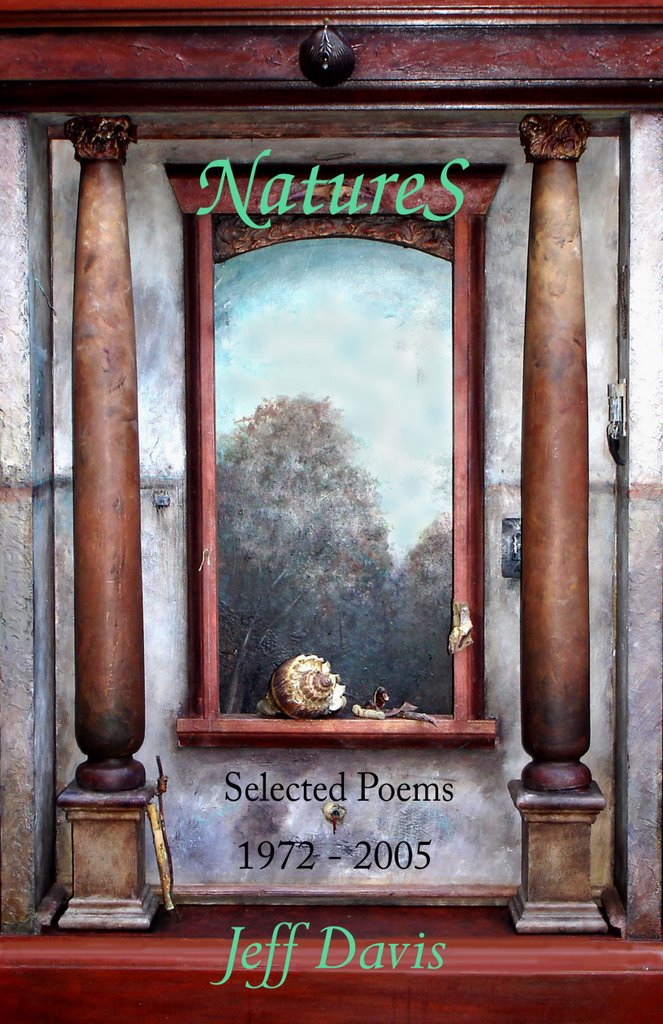
NatureS, a Year Along


So far as I'm aware*, NatureS got about as many reviews as most poetry books do - in this case, one. That one appeared in the Asheville Citizen-Times last October, and was written by Rob Neufeld, who specializes in books exploring local history and folklore. In fact, the review of NatureS followed reviews of a couple other books, one a collection of mountain tales, the other a novel set at Fontana Dam, a resort an hour or so west of Asheville.

Neufeld didn't exactly like the book, and had a couple of condescending things to say about it, but that's all well and good. Here's his take - and this is pretty much the entirety of it (sorry, no link, as it's now behind a paywall):

New Native Press is celebrating the work of Charlotte-now-Asheville poet Jeff Davis with the publication of "Selected Poems 1972-2005." The value of the book is its presentation of a mystical poet's evolution. The early entries are preachy. They expect us to dig the ineffable because, after all, it's ineffable.

Starting with the third of four sections, Davis begins to trust his art. The messages are not substantially different; and the focus on nature remains. But you can enter a beautiful state by forming the words in your mind or mouth.

Hmmm. All publicity is good publicity, I suppose, but at least he could have gotten the actual title of the book right. Oh, well. It was just the Asheville Citizen-Times.

Readers do bring their own heads to the transaction with the text, and I have no wish to over-determine what another pair of eyes, another mind, might find in the poems NatureS carries into the world. But ... (and at the risk of sounding "preachy"), there's a small problem with Neufeld's trope about the "mystical poet's evolution," that being the fundamental one that the poems are not chronologically organized, and therefore don't reveal some sort of linear progress, in good Romantic fashion, of the poet's mind.

It would take delving into boxes of ancient papers to nail it down, but I believe that the earliest poem in NatureS is actually "To the Muse", which doesn't appear until page 34. I still remember well jotting its first lines down on the long ferry ride up the Johnson Straits to Alert Bay, the little fishing village in British Columbia where I lived on and off for most of the early nineteen-seventies. It went through several permutations before it was finished, or abandoned - from an attempt to speak to the nature of a particular love relationship, an attempt that was then reshaped by a Sikh teaching story about (as I remember it, at least) the always nameless Real, eventually to an account of the process of writing as I then understood it.

The poem was substantially finished by 1975. When I was putting the book together in 2004 and 5, a phrase or two reopened, and it changed again, but only by a few words.

It was the first of a number of poems that emerged during the same period, four of which were published in the Vancouver little mag Iron; sometimes, still, I think of them as my "Vancouver poems". That city had then, as I'm sure it must have still, a wonderful community of engaged poets, including the great Robin Blaser, who'd been an integral part of the San Francisco scene that had also included, among others, Jack Spicer and Robert Duncan. The last year I spent in BC, in fact, Blaser published his edition of Spicer's Collected Books, which has yet to be superceded as the standard collection of Spicer's work.** It was a lively scene, with readings almost weekly at The Western Front, Simon Fraser University (where Blaser taught), and various homes and studios around the city.

Blaser had been told by Olson, by Blaser's own account, "I'd trust you anywhere with image, but you've got no syntax," (see "Diary, April 11, 1981", from Blaser's, yes, Syntax), and he'd taken it upon himself, as part of his commission as a poet, to explore strategies for the structure of meaning in language that extended conventional syntax into new territories. His work often structures itself not by explicit syntactic relationship of elements, but by a dynamic parataxis. Looking back, I can see that my own approach to structure and syntax, to the use of fields of meaning opened up by Blaser's work - and that of others, like Daphne Marlatt and Sharon Thesen, working in that time and place - morphed. The poems from Iron represent an intensification of my own experiments with language and form, experiments that seem, to me at least, to have marked a crossing point, a line of demarcation, between earlier work and the poems in NatureS. But, again, this priority is not marked, in any real sense, in the book, and the poems are scattered throughout it, "The Forum in Weeds" at page 22, "The Cotyledon" (in 1975 still untitled) at page 41, "The Bridge" at page 52, and "The Traffic" at page 59.

Indeed, some of the most recent poems actually appear in the first section of the book, including "The Divers", "The Point", "Noetic Issues on the Trail", and "Another Flight", all written within the last few years. Other recent poems scattered through NatureS include "Tithe of Clouds", "Notes in the Common Key", "Toward Pisgah", and "Strata: Melissa" (though it began in the mid-nineteen-eighties as an integral part of "Strata: Rhododendron"). To give Mr. Neufeld his due, the book does close with "Envoi: Another Audition ...", which was in fact the most recent poem included in the book.

So, enough. Or too much. The book can be read in various ways, I'm sure. It's not my purpose to discourage any approaches readers might wish to take to it. They probably shouldn't, though, assume that it's a "progress", and certainly not a linear evolution.

~~~~~~~~~~~~~~~~~~~~~~~~~~~~

* It helps me avoid the vanity of self-Googling that I am named "Jeff Davis"; there's even another poet of the same name, who seems to write books on yoga as well - something that I'll probably never do. Not to mention that other "Jeff Davis", Jefferson Davis, President of the Confederacy, for whom my father (and eventually I) was named.

** Update, 19 May 2009: Now see My Vocabulary Did This to Me: The Collected Poetry of Jack Spicer (Peter Gizzi and Kevin Killian, editors), published by Wesleyan University Press in November 2008.

Labels: , ,