Monday, January 12, 2009

NatureS on Amazon

Looking for some books on Amazon tonight, just for fun I also checked for Natures. So far as I know, New Native, its publisher, has never offered it there, given the hassle involved in becoming an Amazon affiliate. To my surprise, though, it was there.

Price at a Glance
List Price: $12.50
Used:from $29.94
New:from $29.97
Have one to sell? Sell yours here


(Pssst: I can get you a copy for the list price ... and maybe you can make a profit by selling it on Amazon)

Labels:

Wednesday, July 23, 2008

Natures .... just $106.60

An idle BookFinder search, and ...wow. I knew prices were going up, but ...

Natures prices certainly show quite a range:

Used books: 1 - 4 of 4

#BooksellerNotesTotal Price
1 Small Press Distribution
via AbeBooks
[United States]
Publisher: New Native Press
New condition; Poetry. This collection of poems written over the course of a career, like poems from Rappachini's garden, remind us of what we have longed for, as well as what we might have lost. [blah, blah]
2 Half.com
[United States]
Softcover, ISBN 1883197228
Publisher: New Native Pr, 2006
3 Barnes & Noble.com
[United States]
Softcover, ISBN 1883197228
Publisher: New Native Pr, 2006
4 Amazon.co.uk
[United States]
Softcover, ISBN 1883197228
Publisher: New Native Pr, 2006
Used, very good, Ships from USA. Delivered in 10-12 business days. Money back guarantee!, Usually dispatched within 1-2 business days
( All matching used books shown )


Or you could just buy one by dropping me an email for a bit less. I am starting to rethink that $12.50 price, but for now ...

And for $16.00 (plus postage of course, at these prices), you can get both Natures and Transits of Venus, the chapbook that preceded it in the fall of 2005.

(Brought to you by the Shameless Commerce Division here at Wildwood Press)


Labels: ,

Friday, March 07, 2008

Moses high on Mt. Sinai ...


... perhaps very high. Via Lisa Jarnot's ever entertaining lisablog, a story from the UK Guardian in which a researcher claims that Moses might just have been, shall we say, under the influence of something besides the Holy Spirit:

We all know that Moses was high on Mount Sinai when God spoke to him, but were the Ten Commandments a result of divine inspiration alone?

An Israeli researcher is claiming in a study published this week the prophet may have been stoned when he set the Ten Commandments in stone.

According to Benny Shanon, a professor of cognitive psychology at the Hebrew University of Jerusalem, psychedelic drugs formed an integral part of the religious rites of Israelites in biblical times.

Writing in the Time and Mind journal of philosophy, he says concoctions based on the bark of the acacia tree, frequently mentioned in the Old Testament, contain the same molecules as those found in plants from which the powerful Amazonian hallucinogenic brew ayahuasca [my link - Jeff] is prepared.

"The thunder, lightning and blaring of a trumpet which the Book of Exodus says emanated from Mount Sinai could just have been the imaginings of a people in an altered state of awareness," writes Shanon. "In advanced forms of ayahuasca inebriation, the seeing of light is accompanied by profound religious and spiritual feelings."

References in the Bible where people "see" sounds, is another "classic phenomenon", he said, citing the example of religious ceremonies in the Amazon in which drugs are used that induce people to "see" music.

Speaking about his article on Israeli public radio, he added: "As far Moses on Mount Sinai is concerned, it was either a supernatural cosmic event, which I don't believe, or a legend, which I don't believe either. Or finally, and this is very probable, an event that joined Moses and the people of Israel under the effect of narcotics."

Moses was probably also on mind-altering drugs when he saw the "burning bush", suggested Shanon, who admitted to dabbling with such substances.

Speaking of his own experience of ayahuasca during a religious ceremony in Brazil's Amazon forest in 1991, he said: "I experienced visions that had spiritual-religious connotations."

This article was first published on guardian.co.uk on Wednesday March 05 2008, and last updated at 15:59 GMT on that date.

There's a good article by the same researcher, Benny Shanon, here (it's a .pdf); it's a consideration of Psychoactive Sacramentals, an anthology of articles on the role of entheogens in religions, including Judaism and Christianity.

Gordon Wasson, Carl A. P. Ruck and their co-authors have previously explored some of the same terrain in their Persephone's Quest and the classic Road to Eleusis (see here for a .pdf that includes much of the book). Fascinating, if you're at all curious about how we came to be the strange creatures we are.

(The Road to Eleusis
, including the great Homeric Hymn to Demeter, helped me delve into the Eleusinian materials that I approached/appropriated/attempted to locate myself within in some of the poems in NatureS.)

~~~~~~~~~~~~~~~~~~~~~~~~~~~~~~~~~~~~~

Rembrandt's Moses from Olga's Gallery.

Labels: , , , , ,

Friday, February 22, 2008

NatureS on the air, now, actually

Well, last week’s show with Lori Hovitz was permanently lost in the aether, but the show from the week before, in which I give my first reading of NatureS, to the delight, amusement, and/or consternation and utter bafflement of an audience at the Black Mountain College Museum + Arts Center, back in April, 2006, is now actually up, ready to be streamed or podcast from the WPVM Archive page. Enjoy.

This week (2:00 Sunday) we’re hosting the very literate singer/songwriter Angela Faye Martin, who’s said she’s bringing her guitar.

(We do like to mix things up.)

~~~~~~~~~~~~~~~~~~~~~~~~~~~~~~~~~~~~~

Cross-posted at WPVM.


Labels: , , , , ,

Saturday, February 16, 2008

This week on Wordplay: Natures


This week’s show, still available via stream or podcast from the WPVM archive page, features my debut reading of NatureS from April, 2006. The reading took place at the Black Mountain College Museum + Arts Center, and I talked a bit about the Black Mountain poets, especially Robert Creeley, and my sense of their relevance to my own work. I also wanted to speak to the poetics that informs the work, and so spent probably too much time talking about parataxis, as practiced particularly by Robin Blaser, and about Novalis, whose Encyclopedia explores the identity of the character each of us calls “I” in a way that remains useful some two hundred years, now, further on.

Listening to the recording for the first time just ten or twelve days ago, I realized that I had seriously mangled my recapitulation of Creeley’s account of the rhinoceros argument between Wittgenstein and Russell. Wittgenstein refused to agree with Russell’s assertion that there was no rhinoceros in the room, and Russell, so the story goes, tried to prove to him empirically that, in fact, no such creature was around; he looked under tables and chairs, and so on. My telling scrambles Wittgenstein’s position, and so obscures the import of the whole argument - and, sadly, likewise obscures the humor of the situation as legend tells us it unfolded. When Creeley told the story, he managed to keep that humor. My apologies to Bob’s spirit, and to any who might listen to this version, for getting things scrambled in my jangled brain that night.

We don’t offer feature our own work on Wordplay, but we had a week with no guest on board, and I’d been having difficulties cleaning up a noisy recording of Jonathan Williams that I wanted to air, … so there it is. Enjoy. We’ll hopefully be able to include the Williams reading in a future show.

~~~~~~~~~~~~~~~~~~~~~~~~~~~~~~~~~~
Update: Coming up Sunday (or Monday via stream and podcast), Lori Horvitz.

Labels: , , ,

Wednesday, May 30, 2007

NatureS: Joyce Blunk's Constructions

One of the great pleasures of putting NatureS together was getting to know Joyce Blunk and her work. While photographs of five of her constructions do grace the text, four of them are monochrome and therefore don't really convey particularly well the impact of the pieces featured. To celebrate the book's anniversary, here they are in color. Click on the images for (much) larger versions.

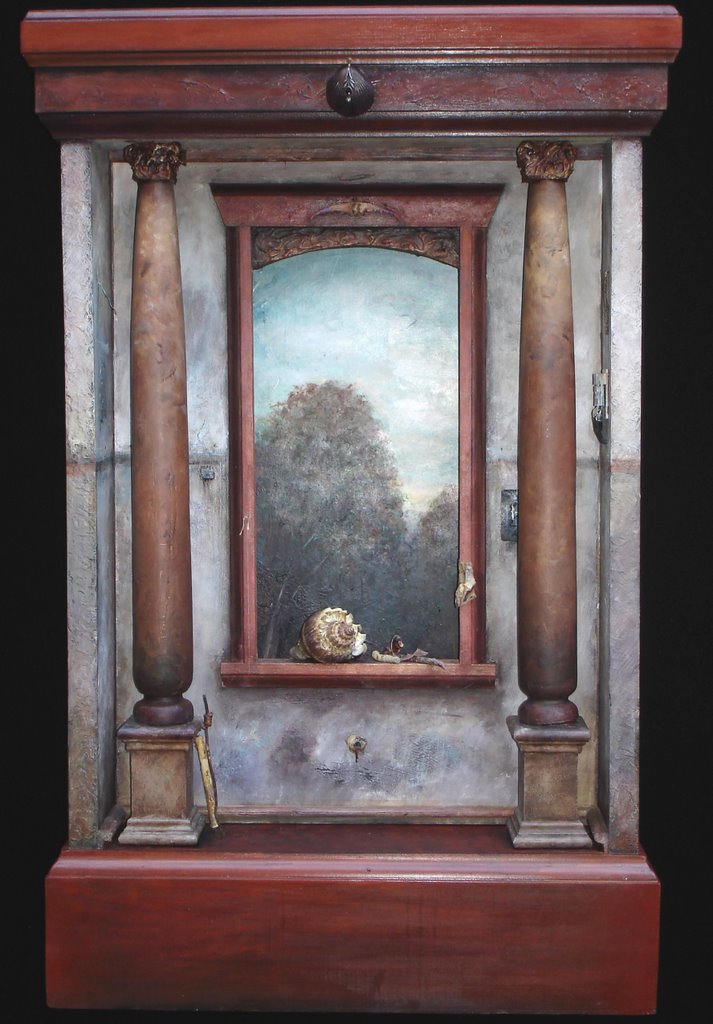
To the left, "Crown Conch," a detail of which became the basis for the cover of the book. It includes among its materials wood, paint, metal, plastic, and shells. It measures 17x27x6 inches.


The construction that appears on page 1, titled "Locust Pavillion," consists of wood, paint, metal, shells, paper, and seed pods, and measures 15x31x5 inches.


The piece on page 23, titled "Weeping Garden," is made of wood, paint, shells, glass, cloth, pods, and metal, and measures 15x26x5 inches.


The piece on page 47, titled "Deep Autumn, Asheville," is built of wood, paint, metal, shells, seed pods, and string.


The piece on page 73, titled "Nothing Left," constructed of wood, paint, wire, bones, and a teabag, measures 12x20x4.5 inches.


And here's a detail of "Nothing Left", just to give a closer looks at its intricacies:


Thanks again to Joyce for sharing them.

Labels: ,

Friday, May 18, 2007

NatureS, a Year Along


So far as I'm aware*, NatureS got about as many reviews as most poetry books do - in this case, one. That one appeared in the Asheville Citizen-Times last October, and was written by Rob Neufeld, who specializes in books exploring local history and folklore. In fact, the review of NatureS followed reviews of a couple other books, one a collection of mountain tales, the other a novel set at Fontana Dam, a resort an hour or so west of Asheville.

Neufeld didn't exactly like the book, and had a couple of condescending things to say about it, but that's all well and good. Here's his take - and this is pretty much the entirety of it (sorry, no link, as it's now behind a paywall):

New Native Press is celebrating the work of Charlotte-now-Asheville poet Jeff Davis with the publication of "Selected Poems 1972-2005." The value of the book is its presentation of a mystical poet's evolution. The early entries are preachy. They expect us to dig the ineffable because, after all, it's ineffable.

Starting with the third of four sections, Davis begins to trust his art. The messages are not substantially different; and the focus on nature remains. But you can enter a beautiful state by forming the words in your mind or mouth.

Hmmm. All publicity is good publicity, I suppose, but at least he could have gotten the actual title of the book right. Oh, well. It was just the Asheville Citizen-Times.

Readers do bring their own heads to the transaction with the text, and I have no wish to over-determine what another pair of eyes, another mind, might find in the poems NatureS carries into the world. But ... (and at the risk of sounding "preachy"), there's a small problem with Neufeld's trope about the "mystical poet's evolution," that being the fundamental one that the poems are not chronologically organized, and therefore don't reveal some sort of linear progress, in good Romantic fashion, of the poet's mind.

It would take delving into boxes of ancient papers to nail it down, but I believe that the earliest poem in NatureS is actually "To the Muse", which doesn't appear until page 34. I still remember well jotting its first lines down on the long ferry ride up the Johnson Straits to Alert Bay, the little fishing village in British Columbia where I lived on and off for most of the early nineteen-seventies. It went through several permutations before it was finished, or abandoned - from an attempt to speak to the nature of a particular love relationship, an attempt that was then reshaped by a Sikh teaching story about (as I remember it, at least) the always nameless Real, eventually to an account of the process of writing as I then understood it.

The poem was substantially finished by 1975. When I was putting the book together in 2004 and 5, a phrase or two reopened, and it changed again, but only by a few words.

It was the first of a number of poems that emerged during the same period, four of which were published in the Vancouver little mag Iron; sometimes, still, I think of them as my "Vancouver poems". That city had then, as I'm sure it must have still, a wonderful community of engaged poets, including the great Robin Blaser, who'd been an integral part of the San Francisco scene that had also included, among others, Jack Spicer and Robert Duncan. The last year I spent in BC, in fact, Blaser published his edition of Spicer's Collected Books, which has yet to be superceded as the standard collection of Spicer's work.** It was a lively scene, with readings almost weekly at The Western Front, Simon Fraser University (where Blaser taught), and various homes and studios around the city.

Blaser had been told by Olson, by Blaser's own account, "I'd trust you anywhere with image, but you've got no syntax," (see "Diary, April 11, 1981", from Blaser's, yes, Syntax), and he'd taken it upon himself, as part of his commission as a poet, to explore strategies for the structure of meaning in language that extended conventional syntax into new territories. His work often structures itself not by explicit syntactic relationship of elements, but by a dynamic parataxis. Looking back, I can see that my own approach to structure and syntax, to the use of fields of meaning opened up by Blaser's work - and that of others, like Daphne Marlatt and Sharon Thesen, working in that time and place - morphed. The poems from Iron represent an intensification of my own experiments with language and form, experiments that seem, to me at least, to have marked a crossing point, a line of demarcation, between earlier work and the poems in NatureS. But, again, this priority is not marked, in any real sense, in the book, and the poems are scattered throughout it, "The Forum in Weeds" at page 22, "The Cotyledon" (in 1975 still untitled) at page 41, "The Bridge" at page 52, and "The Traffic" at page 59.

Indeed, some of the most recent poems actually appear in the first section of the book, including "The Divers", "The Point", "Noetic Issues on the Trail", and "Another Flight", all written within the last few years. Other recent poems scattered through NatureS include "Tithe of Clouds", "Notes in the Common Key", "Toward Pisgah", and "Strata: Melissa" (though it began in the mid-nineteen-eighties as an integral part of "Strata: Rhododendron"). To give Mr. Neufeld his due, the book does close with "Envoi: Another Audition ...", which was in fact the most recent poem included in the book.

So, enough. Or too much. The book can be read in various ways, I'm sure. It's not my purpose to discourage any approaches readers might wish to take to it. They probably shouldn't, though, assume that it's a "progress", and certainly not a linear evolution.

~~~~~~~~~~~~~~~~~~~~~~~~~~~~

* It helps me avoid the vanity of self-Googling that I am named "Jeff Davis"; there's even another poet of the same name, who seems to write books on yoga as well - something that I'll probably never do. Not to mention that other "Jeff Davis", Jefferson Davis, President of the Confederacy, for whom my father (and eventually I) was named.

** Update, 19 May 2009: Now see My Vocabulary Did This to Me: The Collected Poetry of Jack Spicer (Peter Gizzi and Kevin Killian, editors), published by Wesleyan University Press in November 2008.

Labels: , ,

Friday, August 04, 2006

Back to Waynesville

I'll be cruising back to Waynesville tonight for an authors' reception at Windows On Main, in the heart of town. It's a prelude to the Book Fair tomorrow, across the street at the Justice Center. Like many other authors, I'll be there at the Fair, hopefully signing copies of books for interested readers.

The reception starts at 6:00 tonight. "Heavy hors d'oeuvres will be served and door prizes will be given. Tickets are $15.00 and are available at" Osondu Booksellers, according to Osondu's website. Other authors scheduled to be there tonight include Darnell Arnoult, Michael Beadle, Billie Bierer, Regan Black, Marian Coe, Scott Dickson, Sherry Fair, Struan Forbes, Marshall Frank, Alan Gratz, Tommy Hays, James Joyce, Schuyler Kaufman, Vicki Lane, John Malone, Roger Meadows, Clyde Ray, Elva Sieg and Haywood Smith. Hmm, James Joyce? I know just a few of these folks, and am curious to meet others - especially mystery writer Vicki Lane, who sets her stories in Madison County. As it turns out, we have mutual friends.

If you've thought you might eventually get a copy of NatureS, the Book Fair might be a good time to do it; there are other readings coming up, several in and around Asheville in October, but the first printing is almost gone. If you're involved in that side of book collecting, and prize first printings, unique states of publication, and the like (as I confess I do at this stage of my life) you've been advised. Just saying ...

Labels:

Tuesday, August 01, 2006

Gads! NatureS a "Notable Book"

Kay Byer, North Carolina's fine Poet Laureate, has selected NatureS as one of her "Notable Books" by North Carolina writers for the month of August. She's chosen a few poems that are also featured on the Jargon site, but also a couple of others not to be found there. Tom Meyer provides a kind introductory note, and the Arts Council's site wizards managed to include images of several of Joyce Blunk's magnificent constructions as well.

If you go to the page, though, you'll have to scroll down, because the top of the page features August's other Notable Book, Thomas Rain Crowe's Zoro's Field, which Kay asked me to introduce; I was more than happy to oblige.


Zoro's Field has won other recognition in tha last few months, as well. Thomas was awarded the 2006 Philip D. Reed Award from the Southern Environmental Law Center for it. The award, given annually for "outstanding writing on the southern environment, seeks to enhance public awareness of the richness and vulnerability of the region’s natural heritage."

Earlier this year, he won the Ragan Old State Award given by the North Carolina Literary and Historical Association for the best book of nonfiction about North Carolina.

Zoro's Field heads to paperback and, hopefully, even more recognition this fall. Details here.

Labels: , ,

Thursday, July 06, 2006

Updated: The Reading at Osondu ...

... starts early, at 6:00. I was uncertain myself, and so called them, since I figured I ought, you know, to be there for it. So it's 6:00.

No mention of the reading on Osondu's site, but, then, they don't seem to mention much there; I'd guess web presence isn't a focus for them.

The store is at 184 North Main Street in Waynesville, which sounds like it's right downtown. The store's telephone 828.456.8062, in case you need directions.

See some of you there, I hope.

Update: The reading really is at 6:00, since Osondu advertised it for that time. Unfortunately, the WNCW arts calendar and various other media have publicized it for 7:30, the time I originally had it scheduled for as well. Okay ... It's occasions like this one that persuaded me back in the 70s that there just might be something to astrology, even if it did drive my secular materialist friends into apoplectic states when I'd venture to talk about it. Mercury, you see, messenger of the gods, master of communication, just went retrograde; during his apparently backward motion, things he rules are likely to be a bit, shall we say, trouble prone. If you do come out tomorrow night, be a little more vigilant than otherwise on the road.

And if enough people show up at 7:30, what the hell, we'll have another reading.

Update 2: And I see my Blogiversary has rolled around, though that first post was mostly a matter of seeing if this Blogger thing worked. It did.

Labels: ,

Wednesday, June 21, 2006

Solstice, Summer

Today at 8:21 AM EDT the axial tilt of Earth that produces our seasons brought the Sun to its northern zenith, and so gave us Solstice, the point at which the Sun, Sol, appears to pause before it gradually retreats toward the south, bringing us once again autumn and winter, and Persephone returned once again to the depths of the Underworld. For now, though, She's here among us. It's been a moment to celebrate for millenia.

The folks at Jargon Books are celebrating this year with a Solstice page and a selection of the poems from NatureS as well as the photo of Joyce Blunk's "Weeping Garden" that I've uploaded here too. Tom Meyer's crafted elegant pages, as usual, so please do go feast your eyes.

It's a pleasure and an honor to be in such good company.

Happy Summer.

And Happy Birthday to my son Bryan, who turns twenty today somewhere in the vicinity of Barnaul, in the West Siberian Lowlands, just before he leaves for the Altai Mountains. I look forward to hearing someday before too long the stories he'll be able to tell of his travels. Take care, B.; I hope you're thriving.


Update 2:35 PM: The link to the solstice page is down at the moment, so I've linked directly to the selection from NatureS for now. I'll replace that link as soon as the Solstice Page is back online.

Update 6:55 PM: The link is now fixed.

Labels: ,

Thursday, June 08, 2006

Reading at City Lights

Tomorrow evening I'll be reading from NatureS over in Sylva, at the wonderful City Lights bookstore; I'd have had a note up earlier, but Blogger has been down more-or-less constantly for days - as you probably know, if you read Atrios or Digby or ... a host of others, as many have mentioned it. Argh.

Anyway, here's the City Lights notice of the reading:


(Fri. 6/9) Poetry Reading with Jeff Davis
~~~~~~~~~~~~~~~~~~~~~~~~~~~~~~~~~~~~~~~~~~

Please join us on Friday, June 9 at 7:30 p.m. for a reading and booksigning with poet Jeff Davis. A long- time resident of Asheville, Davis will be celebrating the publication of his selected poems, NatureS, which is being published by Thomas Rain Crowe'’s New Native Press in Cullowhee. Area residents perhaps know Davis from his thoughtful articles as a features writer for Rapid River and for his role as one of the hosts for the WPVM radio show “'WordPlay'.” A renaissance man, he studied with Fred Chappell and Robert Creeley, and has also taught at UNC-A as assistant professor of Anthropology, worked as a baker and photographer, and founded a computer programming and trouble-shooting business. The poems in NatureS were written over the course of a career, and are love poems to and of nature, to and of flesh. The many natures of what we, as humans, are, as well as what we strive for, wish for and dream of. Davis'’s poems in this collection are place-specific to the western North Carolina mountains, their fauna and flora, their cultures and seasons. Commenting on Davis's new book, western North Carolina's own Jonathan Williams has written: "“I divide poetry into what I can read and what I cannot read. I am new to Jeff Davis'’s work but hit'll read!!! It reminds me that writers named Robert Creeley and Charles Olson once taught at Black Mountain College in Buncombe County, NC - and made a difference."

The June 9th event will include a formal reading by Davis followed by refreshments and an opportunity for those in attendance to meet and talk to the author and to buy signed copies of the new book. The evening is free and open to the public.

That's lightly edited; City Lights originally had Joyce Blunk attending also, but she has family in town and won't be able to make it. And they'd promoted me to associate professor, which I wasn't. I'm not so sure about that "renaissance man" thing, but thanks anyway. And since they mention Fred Chappell, I suppose I'll have to tell my Fred story. Fred, in an oblique way, actually made it possible for me to go to Buffalo and study with Robert Creeley, and others, though I'm sure that's not what he had in mind.

Juicy details at the reading. And if you can't make the reading, I'll post the story here sometime next week - assuming Blogger permits it. Computer (or, more often, software) weirdness has contributed to my livelihood over the years, and I'm usually grateful for the opportunity to figure out what the hell is going on, but sometimes ... Unfortunately, in the case of Blogger, all one can do is wait while the guys in California come to grips with whatever's whacked the system.

Labels: ,

Monday, May 22, 2006

On the Way to NatureS

This past winter, going through a box of old photographs recovered from my mother's house, I came across a faded and cracking color eight by ten of the groom's party from my brother's wedding in 1971; the party, of course, included me, back from British Columbia for the summer. Not wanting to defame any of the other members of that crew, I've cropped it to leave just the guy you see on the left, the poet of NatureS about the time he began the first of the poems which make up the book. That day seems, certainly, quite a while back. Some friends who've known me only in the last ten years tell me that they can't see me in this photo at all, but I know for sure that I'm at least his more-revealed descendant, and every now and then I come across him when I'm digging into the language I (he could claim the same pronoun) still use.

For the reading last month, I actually thought I might make a photo mask from this image and wear it when I was reading from the older material in the book, just so folks would have some visual sense of the person whose statement and song they then heard. Perhaps for a future reading. But, for now, it's here.

Several have written to ask where they might buy the book. Thanks! It's available online now, with the convenience of a shopping interface, through SPD, and also from New Native Press. In Asheville, it's available from the Captain's Bookshelf at 31 Page Avenue, near the Grove Arcade, and at the Black Mountain College Museum + at 56 Broadway (each copy there and at Captain's is signed, if you're interested in that aspect of book collecting, and contains a flier from the Center reading in April or some other piece of cool stuff for the true collector). Malaprop's will have it at some point, I'd assume, since they've scheduled a reading in October, but they didn't have it as of yesterday. More about Malaprop's as the fall approaches. In the meantime ... how does it go? Yes, do buy the book, buy several copies, give them to friends! They'll make great gifts for the holiday of your choice! Etc.

Labels:

Wednesday, April 26, 2006

NatureS: The Celebration

This Friday, the 28th, I'll be reading from NatureS, now officially published, at the Black Mountain College Museum + Arts Center. I'm happy it's done, delighted with the production of the book, and hope anyone who might read this note will feel welcome to drop in. Things get underway at 8:00 o'clock.

It's a curious thing, I admit, publishing a first book past 60; I hope George Eliot was right that "it's never too late to be what you might have been." For me it's come to seem simply a way to participate in the conversation of the time in which I live. Over the past three years, as I've been working on the book, I've reconnected with poet friends from times and places past, and met younger poets working their way toward their own modes of statement, and I've enjoyed it immensely. There's a whole level of psyche that such a community of persons so actively engaged with imagination sustains.

Hiking a trail here in the Smokies you'll sometimes come across a point along a ridge, a rocky promontory, that, climbed, offers view of the terrain traversed. Making the book has been such an occasion, a chance to see where I've been and what sense I've managed to make of the journey - so far! From the outcrop, after all, you also get a look at the territory that remains to be crossed.

If you're in town, I hope you'll come help me send these songs off into the world.

********************************
The poster for the reading was created by the talented Clare Hubbard, intern at the Center and student at Warren Wilson College in Swannanoa.

Labels: ,

Sunday, April 02, 2006

NatureS: Joyce Blunk's "Crown Conch"

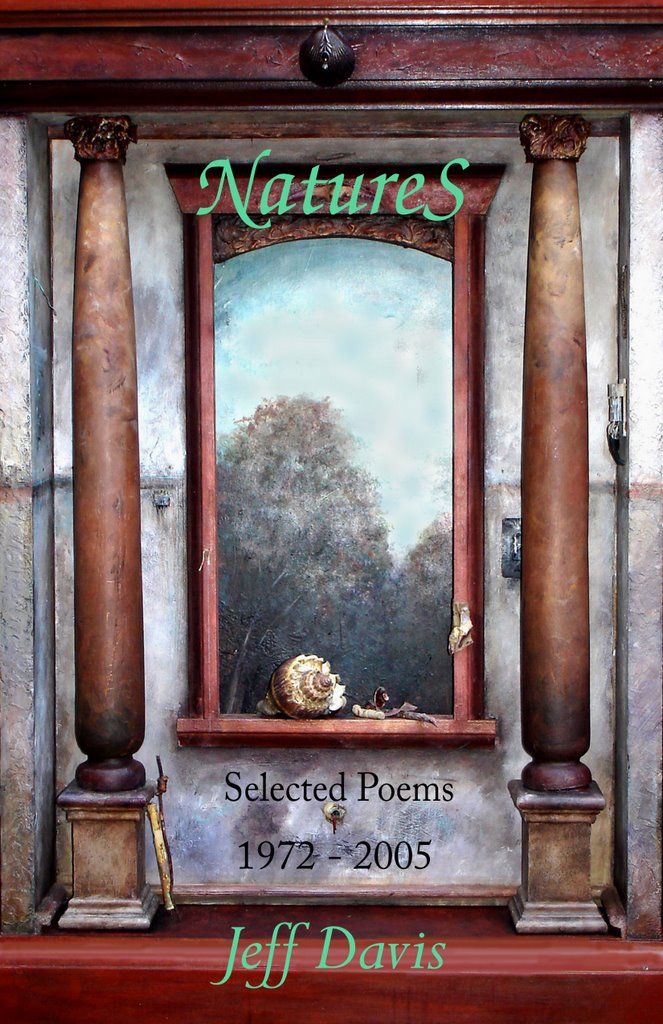
One of the pieces by Joyce Blunk that I found (and find) really involving, one that conjured up a world for me, she's named, for obvious reasons, "Crown Conch". It's central image and columnar frame will be featured on the cover of NatureS; the photo at left includes the whole contruction. A couple of weeks ago I asked her how she's gone about developing it.

Jeff: I am intrigued by your description of your work process, and your statement that “a particular object is usually the starting place.” Would it be reasonable to speculate that the conch is the starting place for “Crown Conch”? Clearly, a lot happened after it got started! And I could offer you a hundred questions about just that piece. But let me ask just one: What came next, after the conch?

Joyce: “Crown Conch” is a 1997 box and I was interested at that time, and still am, in constructions dealing with windowed interiors revealing an element of deep space by incorporating the illusion of distant landscapes. I was after a contrast created between the romantic beauty of the landscape and a starker reality of the interior. Most of these pieces show lush mountains at the changing of seasons and at a time of day when the light is moody and transitional. The predominant feeling, for me, is nostalgia, yearning, and a great melancholy. The shell, in this case, was added to the box when I had nearly finished. It seemed to really fit, and I liked the idea of the conch being isolated and removed from its origin. The shell is transformed by being presented in a formal and ceremonious way, altering the viewer’s way of seeing it.

After “Crown Conch” I did a box with a closed-in interior, a porch or vestibule, and an Egyptian theme. As you know from your own work, early ideas pop up in new ways again and much later. “The Egyptian Fish” revisits the subject of trophies, those display objects that symbolize personal superiority, prowess, and victory. In this instance, the “trophy” started out as a fish skeleton some German friends found in Egypt and sent to me. Collected and enshrined objects are at the forefront of all the trophy-theme pieces, but not far away there is always evidence of struggle and emotional expenditure. An important aspect is that the tallying up and showing forth always associated with trophies take place in a relentless state of deterioration and change, so that the pride in accomplishment is eroded by an ironic sense of futility.
It might have been a reasonable speculation on my part, but "Crown Conch", as Joyce says, didn't begin with the conch at all. It seems to have begun, instead, with the contrast between interior and exterior, and the sense of loss and dubious consolation implicit in the terms of that contrast for her.

Joyce will be showing "Crown Conch" and several other of her constructions on April 28th, for the publication party for NatureS at the Black Mountain College Museum + Arts Center . The book, after three sets of proofs, is now in the press, and should ship literally any day. More information on the festivities in the days ahead.

********************************

The photo of "Crown Conch" is by Joyce Blunk.


Original content © 2006.

Labels: ,

Thursday, March 16, 2006

NatureS: An Interview with Joyce Blunk

One of the great pleasures of putting together NatureS has been getting to know the work of Joyce Blunk. I didn’t know Joyce or her work at all when I started digging through files and notebooks for the poems that have come to constitute the book; Thomas Rain Crowe, who’d taken on the task of editing and publishing it for his New Native Press, knew us both, thought our work shared a form of relationship to the natural world, and eventually, gradually, introduced us to one another. He first published work by both of us as guest-editor for issue 2.2 of the online journal Nantahala Review; later, he brought over some slides and prints of Joyce’s work, while sharing with her some of the poems I was passing along to him for the book. Both Joyce and I, I believe, felt the mutual resonance that he’d sensed. It’s been almost a year ago, now, since the afternoon Thomas and I finally drove over to Joyce’s house, and she and I actually met. She was kind enough to take us up to her attic studio and show the collection of objects stored there, waiting till they should find their way into a work – a full human skeleton (what better reminder of mortality?), boxes of locust shells, fibrous bits of palm trunk, lustrous seed pods of various plants, feathers, boxes of magical objects of all sorts. Several of the wonderful constructions I’d admired in photographs were stored there as well, between shows, and so I got to spend some time actually before them, rapt, entranced by their details and the stories at which they hinted.

Joyce, in time, generously allowed us to use photographs of five of these constructions for the book, one for the cover, and four for section title pages. As many times as I’ve seen them now, as the book prepares to go through the press, it’s still a profound pleasure to come across them, and always worth a few moments to look at them yet again, and see what they disclose anew. I’m honored and delighted that they’re there.

Earlier this year I asked Joyce some questions about her life and work. Here’s some of the interview:

Jeff: So…. You grew up in Iowa, I remember, and got your degree at the university there. Were you painting then? Who were important artists for you?

Joyce: Yes, I was born in Iowa and grew up there. My parents and brothers and I lived in Fort Dodge, a medium-sized town, but I often spent summers—especially in grade school and junior high—at my grandmother’s farm. I knew as a kid that I wanted to be an artist. After high school, I went to the university in Iowa City and majored in art. When I graduated I taught for a few years, and then went back to Iowa City for the MFA degree. Yes, I was a painter, and still am. My graduate degree is in painting. But while I was in graduate school I took a multimedia course taught by Hans Breder. It was there that I really began exploring the infinite possibilities of combining any and all materials to create art. I started looking at the work of Lucas Samarias, Robert Rauschenberg, Louise Nevelson, Lee Bontecou, the French artist Arman, George Segal, Edward Kienholz, Daniel Spoerri. And Antoni Tapies, that guy—his work is just so thrilling. Recently I’ve been so moved by the work of the contemporary Spanish artist Carmen Calvo. I saw a large show of hers a few years back in Salzburg, Austria, and I just haven’t been the same since. Then the exciting epoxy sculptures of Frank Gallo, who also attended the University of Iowa. Every day I’d walk past several of his sculptures placed out in the hallways of the art department. And of course the extraordinary boxes of Joseph Cornell have also impressed me. I can remember seeing an exhibit of his at the Museum of Modern Art in New York. I went in at opening time and was shocked to see it was dark outside when I left. As far as painting goes, I look at everything. I’ve always loved the slightly edgy work of Richard Lindner and George Tooker, the formality and content of Edward Hopper, and the incredible tonality of Georgio Morandi.

Jeff: How did you begin to create your constructions? When you work on a painting or a construction, is there a narrative, a story that invents itself about or around the piece as you work? Or are you just working in a disciplined, deliberate way on the visual level?

Joyce: Since childhood, I’ve painted and collected objects, and I guess it was inevitable that the two eventually came together in my work. I’ve just always collected found objects, both natural and manmade, that are interesting to me in any way—texture, symbolic meaning, state of decrepitude, color, shape. In graduate school these objects became more important to me as directly related to my work, and I started actually putting them into or onto paintings to create 3-D assemblages. Sometimes these sculptural collages were arranged on wooden-panel paintings, sometimes they were vacuum-formed under a clear plastic covering, and sometimes I arranged them inside wooden boxes or on shelves that I built. As I work, a particular object is usually the starting place. I start with some “thing” that is interesting to me, an object that generates ideas and reactions from me, and then create a setting for the object that will enable me to visually present those ideas and feelings. The content (or what you call “narrative”) of the piece emerges from building layer upon layer of paint, color, and textures and from the formal presentation of the object. On a visual level, I do work in a deliberate manner, but of course as I progress new images and ideas reveal themselves, so that the finished work is often quite a departure from what I had in mind when I started out. I have to just pretty much let the work go where it wants to, let it tell me what it is supposed to be rather than trying to confine it to some preset plan. I think most artists work that way, whether they are writers or visual artists or musicians or whatever. That’s exactly what the contemporary American visual artist Richard Tuttle was talking about when he said, “If I can free a humble material from itself, perhaps I can free myself from myself…. I think [my work] knows, is smarter than I am, better than I am.” I believe my work is beyond me. You plan a certain amount, and then it becomes both an intuitive thing and a thought-out process that used your skills to take it to its own destination.

Jeff: Are you traveling again soon? What is there about travel that is good for you?

Joyce: For the most part, my working time is spent alone in my studio, so I find it very important to get out and meet other professional artists. Art residencies are a wonderful way to have intensive studio time and to share ideas with others. I’ve been fortunate enough to receive fellowships for foreign residencies as well as American ones, and each has been a great enrichment. The next thing on my schedule is a residency at No Boundaries International Art Colony on Bald Head Island off the coast of North Carolina this November, and further on down the line I have been accepted for another residency, for the month of May, 2008, at Cill Rialaig International Artists’ Retreat in Ireland. I have especially loved the opportunity of working abroad, meeting foreign artists, seeing some great museums in those places, and I have produced some of my best work there. I have remained in touch with many writers and visual artists that I’ve met over the years at artist retreats here in the US and in Europe. Living and working in a place so different from my own studio is a real charge, it’s just so stimulating and does such a lot for me. Last spring I spent almost two months on a residency in this very small Mediterranean fishing village in the far northeast part of Spain. Being in a new place, especially in a foreign country, is always so enlivening. To work that intensely for a long period is a great experience. Then, at the end of the time in Spain, I rented a car for a week and drove through the Pyrenees—it was bliss. I love the excitement and provocation I feel in other cultures—even just the distinctive foreign shape of a door handle or a telephone. And of course the landscapes…. And the textures, my God—things are as old as time. And, you know, all that is bound to influence my work in a new way. Throw in all that, and meeting a lot of new people, and the effect can be life-long. And, if you do good work, a long time after that because the work lives on its own.


Joyce’s work will be part of the publication celebration for NatureS on April 28th (more about that soon), and she currently has work in a juried group exhibition, “Discovering Contemporary Art in the Carolinas”, at the Fayetteville Museum of Art; it runs from March 19 to May 7, 2006. Then, May 26 through July 9, 2006, the National Association of Women Artists will include her work in their group show at the Goggle Works Center for the Arts in Reading, Pennsylvania. She has solo shows coming up at Rockford College in Rockford, Illinois, in 2007, and is in the planning stage for show at Radford University in Radford, Virginia, in 2008. Keep an eye open.

********************************

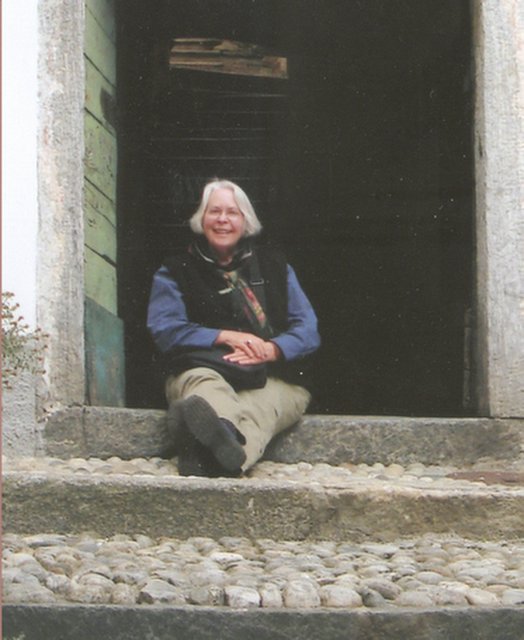
Note: The photo is of Joyce in Switzerland, October, 2005.
Original content © 2006.

Labels: , ,

Monday, January 30, 2006

NatureS, actually coming soon ...

No news from the printer for two weeks, which presumably is good news, since they've been quick to get in touch when there've been problems with the files for the book. So ... it's hopefully done. I think another round of copy editing would have been a trial.

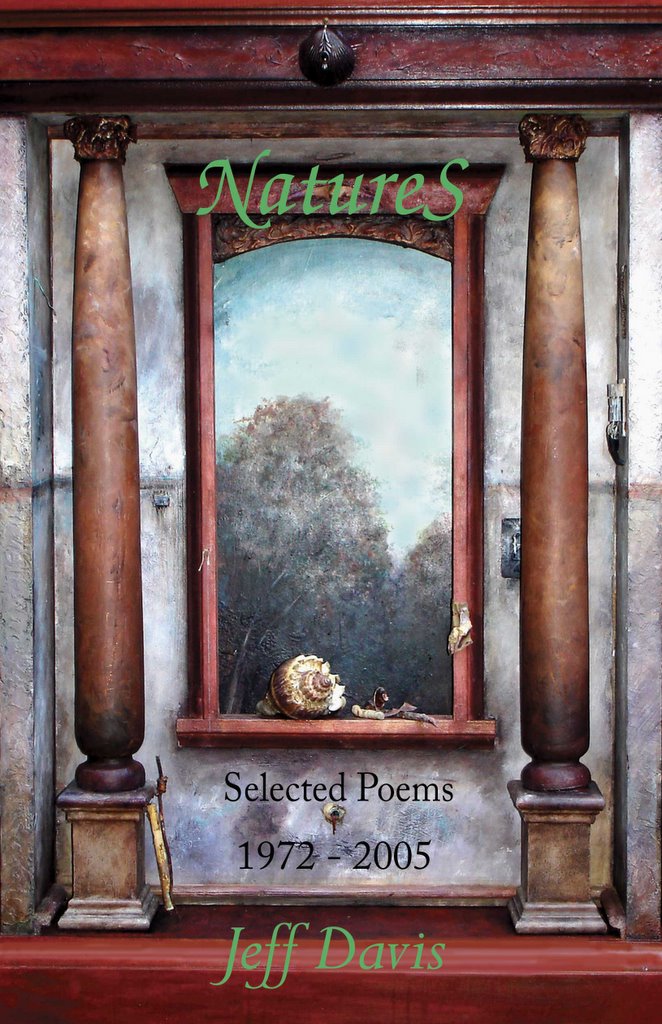
NatureS will include a range of poems from roughly 1972 till last year. I'll be posting more about it as the schedule for it's actual appearance becomes more clear, but for now, here's the front cover.

Labels:

Wednesday, October 19, 2005

Catching Up ...

The reading with Andrea Selch was great fun. It'd been years since I'd read at a venue other than the Center, and it was a pleasure to see some old friends, like Tandy Solomon, who were also fans of Andrea's. I didn't get photos, but perhaps someone else did. I did manage to record the event on my trusty laptop.

After Andrea and I had finished, Tandy, who was our MC for the evening, announced that Emoke Bracz, Malaprops proprietor, a poet herself, had been so energized by our readings that she'd decided to come out and read a poem herself. Sure enough, Emoke came to lectern, and proceeded to recite from memory a long poem - in Hungarian, her native tongue. It was lovely and mesmerizing.

Before the reading Emoke and I had talked, and I'd had to admit that I was a little nervous, so she told me she had a way of getting through the jitters whenever she read: she always started by reciting a poem in Hungarian - she thought it could be in any language, as long as it was other- to settle herself down. I'll never learn enough Hungarian, I'm sure, to perform as Emoke did, but perhaps I'll start readings henceforth with a poem or two by old favorite Rene Char, in French.

The Transits of Venus chapbook did indeed get finished, and is now at Malaprops.

And now the bigger book, NatureS, a selection of poems since 1972, is with the printer, I'm told, so it may be out very shortly also. I've worked on it over the last two years, and am finally happy with the work it contains, notwithstanding the incorrigible youthfulness, shall we say, seen from age sixty, of some of it. More to come about that project, including some poems that the editor and I decided for various reasons to leave out.

Work on the house, meanwhile, continues. Yesterday, when I took the facia board and soffit off the eave at one of the original corners of the house (between rot and carpenter bees, they were in bad shape), I found some pieces of roofing which must have been, given their location, from the house's original roof. I'd already discovered, in scraping, the original paint, so now I've got a mind's eye glimpse of the house's appearance c. 1911: white, with a brick-red roof.

It'll be quite different when I'm through.

Labels: , , , ,