Wednesday, February 23, 2011

Mad Hatter's Review


Issue 12 is now online, and it's pretty amazing. One of the great things about web mags is they don't have to be little; they can offer much more content than traditional hardcopy literary periodicals. And that's true in spades at Mad Hatter's. I've been browsing through it for the past two weeks and don't think I've come anywhere close to the end of it.

Mad Hatter's is the brainchild of new Ashevillian Carol Novack, a.k.a. Loopdeeloopy Lala, the author of Giraffes in Hiding: The Mythical Memoirs of Carol Novack (Spuyten Duyvil Press, 2010), who's appeared ... er, performed? a couple of times already on Wordplay*, and will no doubt return. In addition to the Review, she also curates the Mad Hat's readings, the first two of which were hosted by the Black Mountain College Museum + Arts Center.

Not limited by paper page counts and formats, online mags like Mad Hatter's can offer a wonderful range of content. This issue of the journal features poetry, digital fiction, reviews, stories, creative non- fiction, drama (in audio format, yet), music, and much more - including, even, one of the pieces on Charles Olson I've been working on for the past year. Altogether, aside from the editors, there are one hundred thirty-nine (yes, if I'm counting correctly) contributors.

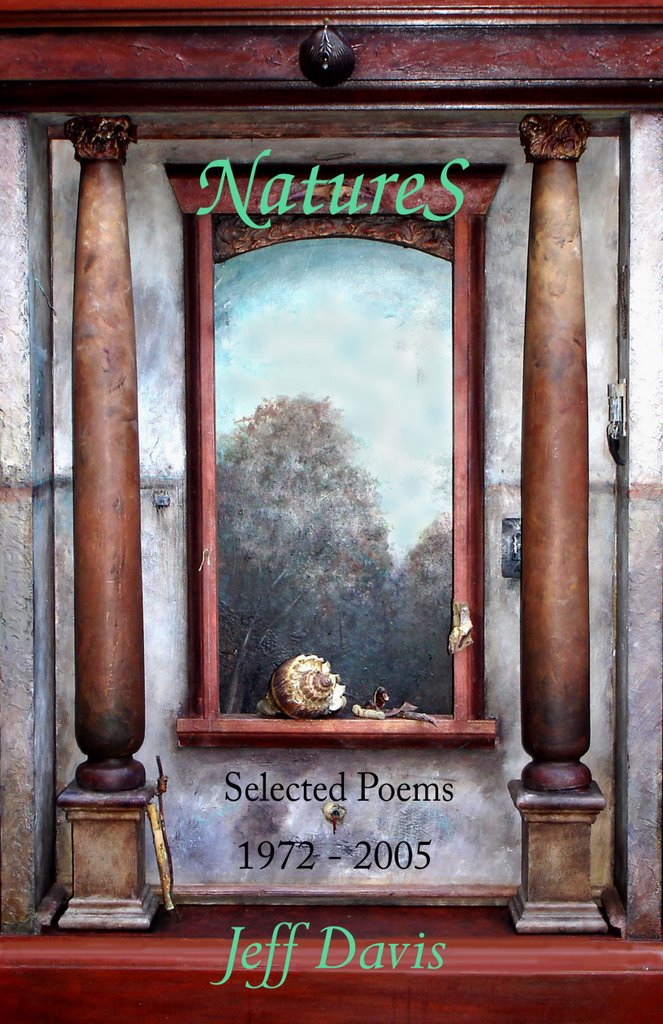
Oh, did I mention that its graphics are truly remarkable? The image at the top of this post, Tree, by Gene Tanta, appears on the home page of the Columns section - and there's a virtual gallery's worth of such fascinating, hallucinatory images over at the site. Anyway, do give it a look.

* One of Carol's shows is now up on the ibiblio archive: August 1, 2010, which I also rebroadcast this past Sunday, since I had to be taping downtown at airtime.

Labels: , ,

Tuesday, May 18, 2010

Programming will resume ...


eventually. Speaking of Olson, I've been spending lots of time with his work, published and unpublished, as I pull together my presentation concerning his curricular projects for the upcoming Charles Olson Centenary Conference in Vancouver. Some of the work may appear here - heck, no doubt it will, at some point. But, for now, if things remain quiet here at Natures, know that I'm at work delving into the pages (and pages and pages) this still under-appreciated poet left us.

And if you're feeling restless and need to take a trip, come on to Vancouver for the first weekend in June. It's a great city, one of the most habitable it's been my pleasure to spend time in, and there's no better way to take on Olson than by immersing yourself for three days in his work.

And now back to Mr. O's "Primordia" ...

~~~~~~~~~~~~~~~~~~~~~~~~~~~~

Photo from the old Looking for Oneself site, which was devoted to Olson's work and featured material from the Minutes of the Charles Olson Society published since 1993 by Ralph Maud. It seems to be gone. If anyone knows what happened to it, do drop me a note or leave a comment.

Labels: , ,

Olson's Maximus Too Much?


Maybe so! At least for the CD player in AshevilleFM's Studio A. It freaked out Sunday and cut short the first three tracks I tried to play from Olson's Maximus Poems. Fortunately, most of the material I'd intended to use for the show was available from the great PennSound website, so I was able to go online and stream the poems I'd programmed. Of course, I'd also planned to use three poems that weren't on PennSound, my own edits from Fred Wah's recording of the 1963 Vancouver Poetry Conference, but, thankfully, the CD player worked fine for them. Go figure.

The glitches did mean that I couldn't include the "Maximus From Dogtown IV" I had on the playlist, but I'll edit it in when I post the show to the WordPlay archive on ibiblio, along with the tracks the player truncated.

Labels: , ,

Monday, December 21, 2009

Charles Olson gets a conference


Charles Olson would turn 99 next week, were he still trooping around on this plane - though, at that age, he might not be trooping very far or very often; he'd be trying, though. I'll be doing a special WordPlay next Sunday to mark the date, and begin my quiet personal celebration of his centenary.

The folks at Vancouver''s Simon Fraser University are marking that centenary in a much larger way, by hosting a conference focused on his work in June of next year. Not much at the website yet, except for registration information, but the range of topics for which they sought proposals looks great. If you don't yet have plans for early next June ... well, it's a great time of the year to visit Vancouver, one of the finest cities in North America.

By way of disclaimer: if the sky don't fall, I'll be there to make a presentation on Olson's curricular projects, along with the many other Olson fans, poets and scholars, some of whom I'm really excited to have the prospect of meeting, having heard of them, known of their work, and/or read them for years. It's going to be a hoot.

More to come.

~~~~~~~~~~~~~~~~~~~~~~~~~
Photo: Charles Olson on the beach, from the Olson archives in Storrs, via the Olson Centenary Conference, straightened back to vertical.

Labels: ,

Friday, September 11, 2009

(Tap) (tap) Is this thing on? Wordplay returns


Wordplay begins its fifth season this Sunday with a program featuring Black Mountain poet Charles Olson and Charles Boer, Olson's student and friend, and also his executor.

This summer, while I was in Storrs, Connecticut, delving into the Olson archives, I had the pleasure of spending an evening talking with Boer - "The Professor", as some of his neighbors know him - about Olson, and about his own work as a translator and poet. Boer was a student of Olson's in Buffalo for the whole of Olson's tenure there, and went on to become a friend and supporter until Olson's death in 1970; it was Boer who helped make the arrangements for Olson to teach at the University of Connecticut in the fall of 1969, in what proved to be his last academic appointment.

After Olson's death, he served as executor of Olson's estate -- helping rescue, in the process, some of the material which has now found its way into the Olson archives.

Aside for his connection to Olson, Boer is a poet and scholar of real accomplishment; his translations of the Homeric Hymns and the Metamorphoses of Ovid rank with the most vital and useful of our era, and his own work is distinct and lively.

Listen this Sunday as Boer reflects on his friendship with Olson, and shares memories as well of Frank O'Hara, Louis Zukofsky, and others who helped define American poetry in the second half of the twentieth century.

And, thanks to the marvels of the recording technology of that era, we'll hear from Olson himself.

As you probably know, Wordplay's now at www.ashevillefm.org (there should be a "stream" button on the site by tomorrow), and airs at 6:00 PM. Though the station is internet-only for now (and may remain that way, given that new digital radio receivers can play internet radio streams), it's much more internet-capable than ... that other station, where Wordplay used to be produced. Though I didn't know it at the time, the other station's site supported streaming for a maximum of thirty listeners. Thirty. The new station's site can support many times that number, so you don't have to get there early.

Hope you'll tune in!

~~~~~~~~~~~~~~~~~~~~

Microphone photo by wickman2k, from Photobucket.

Labels: , , ,

Saturday, August 01, 2009

Up in scenic Storrs ...

I wish Charles Olson had had better handwriting. Guess Massachusetts schools didn't teach the Palmer Method.

I'll be digging through some of the hundreds of folders of Olson's work housed at the Thomas J. Dodd Research Center for a few more days, and then will head back south. Yesterday I came across the first presentation Olson made to the Black Mountain College faculty in 1948; it impressed them enough that they invited him back, of course.

Nine years later, he was the last to leave.

Labels: , ,

Monday, April 07, 2008

Polis Is This: Celebrating the Vision of Charles Olson


Perhaps April is the cruelest month, in T. S. Eliot's antique trope, but in our southern clime, April, with its warmer days, wakes the kingdoms and orders of life that fill our world into the full turbulent florescence of spring. We may still live in Eliot's fallen world, but locally the transformation seems more Chaucerian than Eliotic:

Whan that Aprill with his shoures soote
The droghte of March hath perced to the roote,
And bathed every veyne in swich licour

Of which vertu engendered is the flour ...

The flour buds fill, if they don't yet fully break; birds wing back, bringing their lively songs. And smale foweles maken melodye. Ah, what better season to observe, as we do, National Poetry Month? And this particular April, with the advent of Wordfest 2008, Asheville's first poetry festival in over a decade (and first festival ever of its scope), will certainly bring our fair city bards galore to celebrate the resurgence.

Before Wordfest kicks off on the 24th, though, the long shadow of another poet, a real giant in every sense, one who often foraged through the crammed shelves of the old Pack Library for books to feed his imagination, will once again return to old haunts and flicker for an evening on the silver screen. That poet, of course, would be the one and only Charles Olson.

Olson directed Black Mountain College in its final few years, taught (and taught with) some of the college's gifted poets, and went on to become himself one of the definitive poets of the last century. Next week, on April 17th, filmmaker Henry Ferrini will bring Polis Is This, his fine movie about the man, his vision, his quest, and his legacy, to the Fine Arts Theater.

It's a unique film, in many ways: a documentary, yes, but hardly academic. It feels, instead, deeply personal. Perhaps that's because Henry Ferrini grew up in Gloucester, Massachusetts, where Olson lived much of the time after he left Black Mountain, as the nephew of Vincent Ferrini. Vincent knew Olson, sometimes disagreed with him, but always remained his acknowledged brother in poetry and personal friend. The director came by his interest in Olson honestly, you might say.

Here's what Henry had to say last year about his background in the world of Olson:

All my life I've heard about Charles Olson. As a child around the holiday dinner table I'd listen to tales of a giant who walked the midnight streets of Gloucester, Massachusetts. In school, poets and writers asked if I was related to the Ferrini in The Maximus Poems.

Back home in Gloucester, I'd crack the 600 plus page Maximus Poems to learn a little something about myself and my place in this place. I wondered why Jack Kerouac, Allen Ginsberg, Stan Brakhage, Diane di Prima, and Amiri Baraka made pilgrimage to Olson's $29-a-month flat. What was it about this postman's son, a Harvard trained historian, and the power of his imagination, that made a generation of poets and artists see him as "the big fire source."

How and why America's first fishing town became the portal to Olson's world became a mystery to solve. The poet's methodology, one that he borrowed from the Greeks, became my investigative technique as well. 'Istorin means to find out for oneself. It is the root of our word history and it became the route that I followed.
"Seeing for oneself" became for Olson, as originally for Herodotus, the key to finding actual order in the world - in Olson's case, a world decimated by the Second World War, a war that had brought Europe, theretofore seat of the West's great civilizations, to ruin. It's the historical vision of Olson that makes him unique among poets of the last century or more; he didn't dabble in history, as, say (for all his virtues), his mentor Ezra Pound did. Olson was deeply grounded in it, and had studied it with some of the country's best historians. That grounding helps gives his work deeper ongoing relevance.

The firm base that Henry Ferrini's movie has in that work makes it an important contribution to the understanding of Olson and his legacy. It's also, of course, beautifully shot, has insightful commentary by those (like Robert Creeley) who knew Olson best, and makes fine use of period footage of Olson himself walking, talking, rambling in Gloucester, the town he chose as his vantage point on the world, and called home.

Ferrini brings his film to Asheville in person, and will be on hand after the showing to discuss it and answer questions - which makes the night a perfect time to leap into one of the great worlds that poetry opens.


What: Polis Is This, Charles Olson and the Persistence of Place
Where: Fine Arts Theater, 38 Biltmore Ave, Downtown Asheville
When: Thursday April 17, 2008, 7:00pm
Info Tickets: $7, members of the Black Mountain College Museum + Arts Center and students with ID, $9 others.
Tickets/Info: (828) 384-5050 or
online at www.blackmountaincollege.org


~~~~~~~~~~~~~~~~~~~~~~~~~~~~~~~~~~~~~~~~

This post appeared in somewhat different form in Rapid River, April, 2008.

Labels: , , , ,

Thursday, November 16, 2006

This Week: Celebrating Black Mountain Poets


Sometimes when I'm at Black Mountain's Camp Rockmont, now home to
The Lake Eden Arts Festival, and the former site of Black Mountain College, I wonder what it would have been like to hang out in the dining hall a half-century ago and listen in as the great Black Mountain poets read to one another and discussed each other's work. When Donald Allen placed the Black Mountain College poets first in The New American Poetry: 1945-1960, the great anthology that introduced a generation of experimental poets to a national audience, he might have done so based not just on the quality of their intellectual and formal adventures, but on a solid hunch about the significance their work would assume for the rest of the twentieth century. While they didn't achieve the momentary mass audiences a few of the Beat poets found, it'd be difficult to find another contemporary group of poets who did as much to shape the subsequent course of American writing. The energy of their work has rippled through the imaginations of the several generations and many schools of poets who've come down the road since, and ripples still.

This Friday, November 17th, at 6:00 PM, the Asheville Art Museum celebrates the legacy of these artists with a special evening of poetry that features local poets reading works of these groundbreaking Black Mountain College writers.

Language poet Ron Silliman recently noted on his weblog that when he met Black Mountain poet Robert Creeley in the mid-sixties, he was already the "dean" of American poetry. Ron caught some flack for that; Creeley was only in his mid-thirties, and his mentor, the visionary Charles Olson, was still living, though he had to that point little audience. I think, given that "dean" can imply the lofty heights of academic seniority, that Ron might have chosen a better word. But having met Creeley just a few years after, I can testify that the man had real mojo, genuine moxie, some serious virtu, as Horace might have said, and that by the time he was in his early forties, he had already discovered passes through language that settlers are still trooping through.

"Form is never more than the extension of content," he famously noted. Later he came to acknowledge that the statement was also true if the roles of content and form were reversed. Form embodies content, is the extension of the feeling that's the poem's initial premise. His insight into the nature of poetry, its relations to speech and mind, his consummate feel for rhythm, and his awareness of the fields of meaning within which the language of the poem must dance, make his work one of the enduring testaments of twentieth century poetry.

Charles Olson, certainly one of the most influential poets of his generation, had once befriended Ezra Pound (until he lost patience with Pound's reflexive anti-Semitism), and so provided a bridge back to the great Modernist poets who offered him, and his generation, an initial stance. When he came to Black Mountain College, he'd published a handful of poems and a short critical work on Melville; by the time he closed the College in 1957, he'd published, via Jonathan Williams' Jargon Press, the first two sections of his Maximus Poems, and completed the work that appeared as The Distances in 1960, displaying in both the gift for radical insight into history and the project of consciousness that makes his work of such value.

It was Olson, with his vision of new possibilities for poetry, and for life, who decisively shaped the minds and imaginations of the writers who gathered at the college in its final years. He brought Creeley to the college to teach, and later recruited Robert Duncan. Edward Dorn, John Wieners, and Jonathan Williams, to note just a few of the other significant poets who came through the college's refining fires, had ventured there as students. Other writers, Denise Levertov and Paul Blackburn, for instance, never visited the college, but were published by Creeley in the Black Mountain Review. The Review presented Creeley's and Olson's vision of useful modes of writing to the world, introduced the poets of Black Mountain to a larger community of like-minded writers, and became a meeting place for some of the most creative spirits of the era.

Robert Duncan went on from Black Mountain to become a leading figure in the San Francisco Poetry Renaissance of the nineteen sixties, producing a major body of work that included The Opening of the Field, Roots and Branches, and Bending the Bow, as well as the important late work published in the two collections of Ground Work, republished in one volume just last year. He also authored over a period of decades the amazing HD Book, not yet published in book form, but available at the moment on the web (it's a large .pdf file) in an unofficial electronic format that bears the imprint of the crucial, elusive Frontier Press. It began as a study of the work of Imagist poet Hilda Doolittle (who published as HD), but became a major work on poetic imagination. It's similar, in many ways, I think, to Coleridge's rambling, monumental Biographia Literaria, still one of the indispensable texts of the English Romantic period.

Speaking of that scepter'd isle ... Denise Levertov was English, born in Ilford, Essex, in 1927; she married an American, Mitch Goodman, after World War II, though, and moved to the States in 1948. Her Here and Now, published in 1956, and With Eyes at the Back of Our Heads, published three years later, established her as a major voice in the new poetry. She published more than twenty volumes of verse during her lifetime. Though she and her husband were personal friends of Creeley, her closest relationship with another Black Mountain writer was probably with Robert Duncan, with whom she had a long and illuminating, if sometimes contentious, correspondence, published in 2004.

Ed Dorn is perhaps one of the least well known of the Black Mountain poets, though there's hope that his Collected Poems, due out next year, will bring his work the larger attention it deserves. He was the most contrary of the contrarians who stood at the college, and ever afterwards, against the generalizing mass culture that seemed, seems, to strip individuals of their particularity, of the ability to stand grounded as creative, active participants in the polis of the world. His next-to-last collection, High West Rendezvous, contained sections from "Languedoc Variorum", a major late work that remains mostly in manuscript, which reveal it to be a poem of astonishing technical achievement that also challenges the pious orthodoxies of the history of heresy. It's an amazing, polyvocalic montage that mocks, on one level, the structures of contemporary media news presentation. He had his chops till the end. Unfortunately, it'd probably be next to impossible to perform, so Thomas Rain Crowe, charged with presenting the work of Dorn, will, I hear, read from another, earlier, masterpiece, his Gunslinger.

The reading will feature the works of these Black Mountain poets, and works, as well, by the poets gathered for the occasion: Sebastian Matthews, who organized the event, Thomas Rain Crowe, Jaye Bartell, Glenis Redmond, Keith Flynn, and myself. The reading is a part of the Museum's year-long celebration of Black Mountain College and its legacy in the arts.

Olson died in 1970, Duncan in 1988 , Levertov in 1997, Dorn in 1999, Creeley just last year, but on the 17th of November, the voices of their poems will return to Western North Carolina once again, and ring out.


~~~~~~~~~~~~~~~~~~~~~~~~~~~~~~~~~~

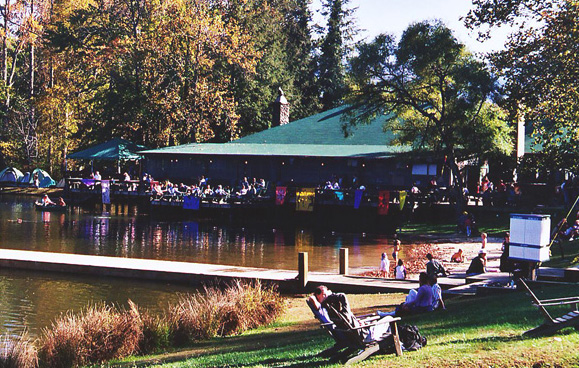
I took the photo of the Dining Hall on Lake Eden in 2003.
This post was published in different form in the November, 2006, issue of Rapid River. Trying to write about the Black Mountain poets in a thousand words or so ... Ha! Well, we'll have more than that to offer on Friday.

Labels: , , , , , , , , ,

Thursday, June 01, 2006

Silliman Takes On Olson


Updated: Ron Silliman has another post up today on Charles Olson - specifically, on Olson's Projectivist poetics. His earlier posts are here and here. While there're issues to take (see below), etc., they're worth a read.

One quibble I have, for starters, is with his attribution to Olson of an error with regard to the smallest unit of sound in language (or, as Olson has it "the smallest particle of all"), the syllable, per Olson. Silliman attributes this error to Olson wading "clumsily" through "his homegrown linguistics", and points out that for actual linguists the smallest unit of sound is the phoneme; phonemes are what characters in a written alphabet are an attempt to transcribe. Even the simple English word "be", Ron notes, contains two phonemes.

For a poet, though, the syllable really is the smallest relevant unit of sound; we don't hear phonemes, just as we don't hear the two in Ron's simple word of choice. Poets work with audible units. And the dynamics of poetry, the somatic grounding of the poem, is the context for Olson's assertion.

Olson can be the most gnarly of writers, but even his apparently offhand parentheses can sometimes crackle with lightning bolts of insight. Ron's is the first attempt I think I've seen to give "Projective Verse" a close reading, and, if I were wearing a hat, I'd give it a tip in his direction for the light he does bring to bear on the Big O! If you're interested in Olson, do check out what the man has to say.

More, surely, later.

********************************
Update: There's now a fourth part up here.


********************************
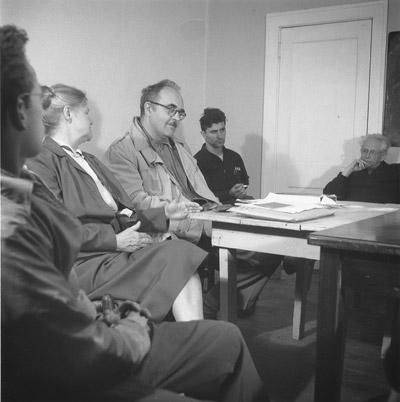
The photo of Olson at a Black Mountain College meeting in the early 50s is by Hazel Larsen Archer. Her work is the focus of Hazel Larsen Archer: Black mountain College Photographer, recently published by the Black Mountain College Museum + Arts Center.

Labels: , ,