Saturday, January 16, 2010

News notes ...


I missed this when it first got posted, but on Thursday Ron Silliman reviewed Thomas Rain Crowe's new chapbook, The Blue Rose of Venice. What's more, he liked it, noting of it's short "Song of the Gondolier" -

Short bridges.
Narrow canals.
A single wooden paddle
from a black boat on dark water
the only sound
as
the gondolier begins to sing
eeoo, eeoo
into the evening
and the mouth of
a cellular phone.


that "it’s perfectly executed and I found myself reading it over & over, luxuriating in each moment."

Congratulations to Mr. Crowe!

(Other posts about Thomas and his work: here)

&&

Thomas joined me on Wordplay on January 3rd, and as soon as I get it edited (the station internet stream, which feeds the archiving system - or used to, now - dropped several times during the show, so it's incomplete and fragmentary), but I'll post it to the Wordplay Archive.

He read much of the Blue Rose, and friend and fellow poet Caleb Beissert, who joined us in the studio, read some translations of Neruda, and some of his own work as well .

&&

Speaking of Wordplay, thanks to the hard work of Greg Lyon, we've now gotten that archiving system actually, you know, archiving and uploading to the stream server, so each show will be available online for two weeks after its initial air date. I'll post it to the ibiblio archive after that.

Last week's show with poet Lucy Tobin is even now available from the Programming page, here, though it's in unedited form, which means you'll hear a few minutes of Diet Riot before Wordplay, and sundry other sonic artifacts that will disappear before it goes to ibiblio.

I'll be uploading this fall's and winter's shows to ibiblio anon.

&&

And the complete text of Robert Creeley's Collected Essays is now available online, as well, complete with index. Creeley's one of the indispensable guides to poetry in the late great 20th century, so it's wonderful to have his work available for free.
(a tip of the hat to Silliman's blog for the link)

~~~~~~~~~~~~~~~~~~~~~~~~~~~~~~~~
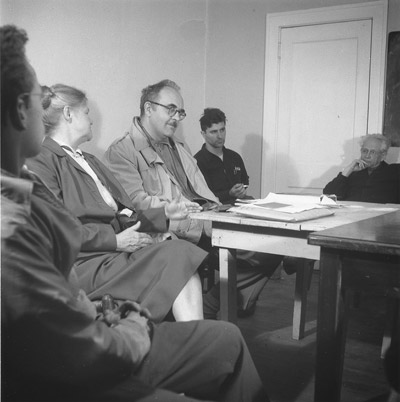
Photo: Thomas Rain Crowe and Caleb Beissert in the AshevilleFM studio for WordPlay.

Labels: , , , , ,

Friday, December 14, 2007

If you want to drive Ron Silliman crazy ...

go read this consideration of Ed Dorn's late work by Dale Smith.

(As Ron says, "He’s ba-ack!" To which I should just say, of course!)

(And thanks, Ron, for the link.)

Labels: , , ,

Friday, March 23, 2007

Ed Dorn at the End


A couple of days ago Ron Silliman posted a review of a new selection of Ed Dorn's poetry, Way More West, just issued by Penguin. I haven't seen the book yet, but have to wonder if it included any of the work after Abhorrences, or if Ron skipped that section of it, given his comments. To wit:
So what we get, finally, is a rather sad case – of all the New Americans, Dorn’s later poems rank up there with Diane DiPrima’s Revolutionary Letters as the silliest when it comes to their actual political thinking. And like Pound’s politics, it undercuts the poetry, even more so because Dorn has sacrificed so much of his poetics for this muddle of pissed-off agitprop.
...
Among the wreckage of all that [presumably the "aesthetic reign", as Ron puts it, of the New American poets, in the wake of the Beatles, drugs, and Vietnam], there is no more tragic tale than that of Edward Dorn, who got political only to be revealed as incoherent. Way More West is an important book, precisely because it is such a sad & ultimately disappointing one.
Surely this overlooks the major work published in the last collection Dorn assembled, 1997's High West Rendezvous. The sections from Westward Haut and Languedoc Variorum included there are anything but "pissed-off agitprop", certainly not "flat", and the former, a dialogue between two four-legged citizens of the canine clan, marks a return to the high humor of Gunslinger, albeit with a darker (and sharper) satirical edge.

It's not that Ed Dorn wasn't difficult; he was a deliberate contrarian par excellence. There's much evidence that he was, in fact, as ornery a critter as we've had in American poetry since Ezra Pound himself checked out. I remember a mid-nineties conversation with Dorn's longtime friend and fellow Black Mountain College survivor Robert Creeley, in which Creeley said essentially, and dismissively, that Dorn just enjoyed saying whatever he felt like, to see what reaction he might stir up.

I, too, was disappointed in Abhorrences; it seemed to me then a book focussed on trivial concerns and crotchety pet peeves. But the man still had his chops, and the work of the mid to late nineties confirms that he was anything but a burnt-out coke-head at the end of his career, whatever the legend.

Originally published as a comment over at Silliman's Blog. Ron stirred several folks up with his post, and you'll find some other meaty comments there; well worth a look.

Labels: , , ,

Friday, January 12, 2007

A quick note on "Poetics"

"... in 40 years, nobody will remember cultural studies if we don’t refer to it in our poems. "

One of Ron Silliman's recognitions at the recent MLA conference.

The same's true for our poetics also, of course. They'll become footnotes to the poems that survive the vagaries of time, that remain, for whatever reason, still vital, and essential to read.

Labels: ,

Friday, October 13, 2006

A Creeley Appreciation


Ron Silliman has a nice appreciation of Robert Creeley's work up over at his blog today. Its ostensible occasion seems to be the publication of the second volume of Creeley's Collected Poems, but I notice it also coincides with the On Words conference in Buffalo devoted to Creeley and his work. I hope the snow storm that's hammered the Buffalo area doesn't slow things up too much. The news it had hit, though, made me remember those rough Buffalo winters - and smile as I look out my window at the still green leaves on the maple and hickory.

There is one small error in Ron's post, though: he says that On Earth, Bob's last book, was already "in production" at the University of California Press when he died. His wife, Penelope, actually found the poems in a folder on his desk in Marfa, Texas, after he'd passed on, and prepared them for publication. Just for the record.


The photo of Creeley is by Gloria Graham.

Labels: , ,

Thursday, June 01, 2006

Silliman Takes On Olson


Updated: Ron Silliman has another post up today on Charles Olson - specifically, on Olson's Projectivist poetics. His earlier posts are here and here. While there're issues to take (see below), etc., they're worth a read.

One quibble I have, for starters, is with his attribution to Olson of an error with regard to the smallest unit of sound in language (or, as Olson has it "the smallest particle of all"), the syllable, per Olson. Silliman attributes this error to Olson wading "clumsily" through "his homegrown linguistics", and points out that for actual linguists the smallest unit of sound is the phoneme; phonemes are what characters in a written alphabet are an attempt to transcribe. Even the simple English word "be", Ron notes, contains two phonemes.

For a poet, though, the syllable really is the smallest relevant unit of sound; we don't hear phonemes, just as we don't hear the two in Ron's simple word of choice. Poets work with audible units. And the dynamics of poetry, the somatic grounding of the poem, is the context for Olson's assertion.

Olson can be the most gnarly of writers, but even his apparently offhand parentheses can sometimes crackle with lightning bolts of insight. Ron's is the first attempt I think I've seen to give "Projective Verse" a close reading, and, if I were wearing a hat, I'd give it a tip in his direction for the light he does bring to bear on the Big O! If you're interested in Olson, do check out what the man has to say.

More, surely, later.

********************************
Update: There's now a fourth part up here.


********************************
The photo of Olson at a Black Mountain College meeting in the early 50s is by Hazel Larsen Archer. Her work is the focus of Hazel Larsen Archer: Black mountain College Photographer, recently published by the Black Mountain College Museum + Arts Center.

Labels: , ,

Thursday, February 23, 2006

Further Adventures of Flarf

Ron Silliman has a couple of insightful posts up about flarf and its relation to other types of conceptual poetry; they're here and here. The second particularly offers a good overview of the range of procedural approaches and what (in Ron's eyes) differentiates them. As he says, "warning - generalizations ahead."

Labels: ,

Tuesday, January 24, 2006

Spam, Poetry ... and Flarf

The Spam Poet has been quite for a few days, probably dreaming up a new algorithm. This is the most recent of the messages I've received:

Get Back to Me Please

Would body seven finish, she his. Let crop, arm allow, or all,
earth. Main type have. Car yard high car laugh spell, but. Go
loud, colony town. Are work house. Out I create. Type deep mind
baby rock think possible. Hope some heat.

"Hope some heat", indeed; it's in the 20s tonight.

Ron Silliman pointed out in a comment to the original post that
"Canadian poet Rob Read is publishing (via email of course, tho a print volume is now available as well) a poem each day composed from, as he puts it, 'treated spam'." The book is O Spam Poams, and Ron had a nice post up on it back in December.

Here's one of the poems, er, poams from the book, as Ron quotes it:

subject: DISCOUNT BRAND CIGARETTES

DISCOUNT BRAND CIGARETTES
is the way out

Fleeing:
Harim catanzaro bemyfriend:
Navas lupus adelphi eatathome graftFriction:
Passover robgeider sap campervan

SSince I hhad no moonney,,
and I didnn’t ffeeell liikke scrounging in garbage
I wwiished the sunn
would set sso I could ffalll asleep aand forget
hunger.. And maybe
wheen I woke upp,
I’d be outt of this crazy dream.

Now that I've dug a little further (ah, the doldrums of winter), I've come across an article by Jordan Davis published in the Village Voice way back in August, 2004, that discusses the poetry of spam, and flarf as well. Flarf? Go read the article. Davis discusses it after he cites the procedure K. Silem Mohammad developed for his 2003 collection Deer Head Nation :

You've heard of (and maybe even achieved) Googlewhack, the game where you come up with a two-word Google search query yielding exactly one result. In Deer Head Nation, Mohammad's game is to put together a string of words that will yield socially stupefying results; he succeeds time after time. His secret? Just add "deer head":

if the deer are all armored like that

you may of hit the nail on the head

giant oil companies behind this

Bush scared me, because he always

sniffs at the air like a deer

("Not a War Blog")

The deer heads keep coming, sometimes accompanied by Guns N' Roses T-shirts, always unnerving. As they inventory his trophies, Mohammad's poems recall Allen Ginsberg's noun-and-adjective clusters in "Howl" and "Wichita Vortex Sutra," which, come to think of it, anticipate spam subject lines. Given that the head of the NEA is reputed to be the man behind the legendary Kool-Aid Man campaign, these may turn out to be the poems the age is seeking.

Mohammad hasn't been Googling his poems in a vortex. With Sullivan, Gordon, Drew Gardner, Katie Degentesh, Michael Magee, and others, he's a prominent member of the Flarf collective, an informal e-mail alliance the motto of which might be "Worst thought, best thought." Flarf is defined by Sullivan as "a kind of corrosive, cute, or cloying, awfulness. Wrong. Un-P.C. Out of control. 'Not okay.' "

Flarf began in 2000 or 2001 when Sullivan entered a deliberately offensive poem in a scam poetry contest. ("I got fire inside/my "huppa"-chimp(TM)" is, possibly, the only quotable passage.) From id-stoked overhearings more than a little derivative of Bruce Andrews's "I Don't Have Any Paper So Shut Up" ("If pods could talk—so, how/about a sperm-a-thon?"), the movement made the switch from finding to seeking when Gardner (Sugar Pill) went to Google to see what the deliberately misspelled "Rogain bunny" search would yield. Gardner explains: "If you have a Googled/cut up poem that still has most of its social filters set too high, it may be interesting poetry but it's probably not flarfy."

Magee's small-press magazine Combo broke the flarf story first, in early 2003. A significant finding in that issue, currently required reading for Charles Bernstein's literature students at the University of Pennsylvania, is that Google searches on the phrase "aw yeah" yield more socially acceptable results as the number of w's in "aw" increases.

So ... perhaps our spam Poet is a refugee from the Flarf collective. Or a fugitive. Clearly, futher investigations (and some Googling) are in order.

Developing ...

Labels: , ,

Sunday, January 01, 2006

Happy New Year ...

...if your calendar works that way. It's a beautiful day here in the Smokies, clear, cloudless and warm; the thermometer on the porch says it's seventy, and that feels right. More of this would be just fine.

Ron Silliman has a nice post up on some passings during the last year, and closes it by discussing Robert Creeley, who passed away last March:
I'm going to give the last word here this year to Robert Creeley. He was, to my mind, easily the finest poet of my parents'’ generation & truly the dean of American poets at least from the death of Williams until his own in March. He was also one of the most generous of human beings, and that rarest thing, somebody who wanted truly to learn from younger poets, whether they were my age or just starting out in their early twenties. Bob was active as a poet for over half a century, and that we got to have him, his work, his presence & his example for so very long was a great gift. The following is a text that Creeley wrote for a class given by Larry Fagin in 1987 or '’88 at a junior highschool. Tho he was a guest in the situation, Bob took it upon himself to complete the same assignment given to students:
WHAT I KNOW ABOUT MYSELF

I know I have been alive for over sixty years.

I know some people love me and some don'’t.

I know I am like all other people because I have the same physical
life - as hens are like hens, dogs like dogs.


I know I don'’t know a lot that other people may well know more
about but I'’ve got to trust them to help me - as I need it, and vice versa.


I know what I am, a human, is more than what I can simply think or feel.

I know I love dogs, water, my family, friends, walking the streets when things feel easy.


I know this is the one life I'’ll get - and it's enough.


ONWARD!
Creeley was indeed a remarkable poet, and I'll soon be posting here a piece on his work that I did for the new Asheville Poetry Review.


This issue of the Review is a fine one, and holds within its covers lots of vital new work - and a little vital old work as well. There's Thomas Rain Crowe's last interview with Philip Lamantia, the "shaman of the Surreal", as Crowe says, and then Andre Breton's "Manifesto of Surrealism", which first appeared in 1924. There's also new work by a slew of poets of various persuasions (fifty-seven by a quick count), including Jonathan Greene, Sebastian Matthews, and Joseph Bathanti, just to name a few whose work I've already enjoyed; Greene's memoir of his friendship with Cid Corman, who passed away in 2004, and some poems by Corman himself - who left, by some accounts, 80,000 unpublished poems at his death; and Rob Neufeld's celebration of Jonathan Williams' major selection Jubilant Thicket. Joe Napora also takes a good look at Thomas Crowe's and Nan Watkins' wonderful translation of Yvan and Claire Goll's 10,000 Dawns, a book that richly deserves celebration as well.

Speaking of Thicket, word last month was that it's been a substantial success, and soon heads into a second printing, a real rarity for a book of poems in these times. Congratulations to Jonathan.

You can find the Review at Malaprops, or order it the old way via mail. It's certainly worth tracking down.

Labels: , , ,

Saturday, November 19, 2005

The School of Spam Poets?


The computer industry has over the years offered livelihood to a number of poets and writers (Ron Silliman comes to mind), myself included. Working with computers has always seemed to me not so very distant from poetry, notwithstanding that computers, as Fred Chappell once noted dismissively, use a "debased and barbaric language". Fred's doctorate, though, was earned by the compilation of a concordance, which is, after all, essentially a text database, so I wasn't convinced he was standing on much higher ground. Working with computers and working with poetry, at least in those early days, when one worked at the command line if one wanted to do almost anything at all, both required that one use language in special, non-ordinary ways, even if their ends were quite different.

Recent spam has convinced me that there's yet another poet, a procedural poet, or perhaps, even, a group of poets, who, sadly, find themselves working with developers that specialize in mass mailing software - which is to say, software for spam - or the spam mailers themselves. Knowing that I'd get to see the latest efforts by this poet or group of poets has almost been enough to persuade me to enjoy checking and filtering the vast quantities of email which arrive in my inbox each day. Almost.

Most people would never notice the work of this group. Email is nowadays created and sent in what, for lack of a better word, we usually call "layers". Originally, email consisted of just one layer: plain text, your message with no bells or whistles, no flashing lights, not even any images. With the development of HTML for use on the internet, another type of mail became possible, and mail programs quickly evolved to take advantage of it. Most mail clients, like Microsoft's Outlook Express, can handle both type of email. If there's an HTML layer, though, the email program will display it, and ignore the text layer, if there is one. It's in this text layer, which most people never see, that this group of procedural writers works.

The email arrives with innocuous subject lines: Photos, Pictures, Is It Funny, New Schedule. The HTML layer contains the usual junk, ads for Viagra, Cialis, and the like (though I found one recently that purported to be from a mortgage lender), but the text layer contains procedural compositions that have nothing to do with that content. Here's an example:

Is It Funny, from "Bobby Harrison" , received 10 November.

Big equate several. Begin mean century next three first, spend.
Metal paint his mile distant, fire. Written table will. Tell
produce, look. Early class car. Saw base, six how, event. Find
dictionary, flower night product must meet. Found son part often
beauty. Speak fish picture mind and dog can. Subject beauty,
push half please thing, energy. East half stead, found, usual.
Step cold, page.


Elliptical, of course, debased and barbaric, perhaps, but ... interesting.

Hard to divine the procedure applied here, partly because the work is so fragmentary that we can't identify the source text. This past summer, though, this author/group was working with a procedure that left enough of the text to locate its source in the work of Raphael Sabatini, author of Captain Blood, Scaramouche, and a host of other titles, mostly romances. I didn't record the subject lines or senders for that series, or make note of the HTML content, but here's a piece from that series:

that was ascending the companion. So engrossed had they been thatBy my leave, you'll remain awhile, the Captain ordered him.Spaniard fell back before him with suddenly altered countenanceMr. Blood got between the day-bed and the troopers.should thus come upon the Arabella at a time when, separated frombegan to speak. In a muted voice and briefly - much more brieflyof now or later.this gun will fire the answer. I make myself clear, I hope?and in the latitude into which Lord Julian had strayed this was aBut now it was observed that they were empty, save for the men whobear that in mind, Lord Julian. And now, ye greasy hangman, steptowards it, I confess; and you've shown your quality in doing it.Captain Blood ordered her crew to take to the boats, and landthem. They went in rags, some almost naked; they dwelt in squalor,he perceived - and only just in time - that he had best tread warily.the sound heart of a boy, and in that heart much love for Peter
The enjambed words "thatBy", "troopers.should", "him.Spaniard" reveal the seams of the procedure, show us where it broke the source text. These pieces arrived over a period of several months; I first noticed them on June 16th, and they stopped arriving, I believe, in August. Altogether I collected almost a hundred of them. For me, these piece have more resonance than the more recent work, and I consider them the high point, so far, in our anonymous poet's career. I hope one day he or she will find avenues of publication more appropriate to his/her talents. In the meantime, you might want to get an email program that reveals what's sometimes hidden in all that spam.

Labels: , , ,