Tuesday, February 16, 2010

Bill Knott's offer


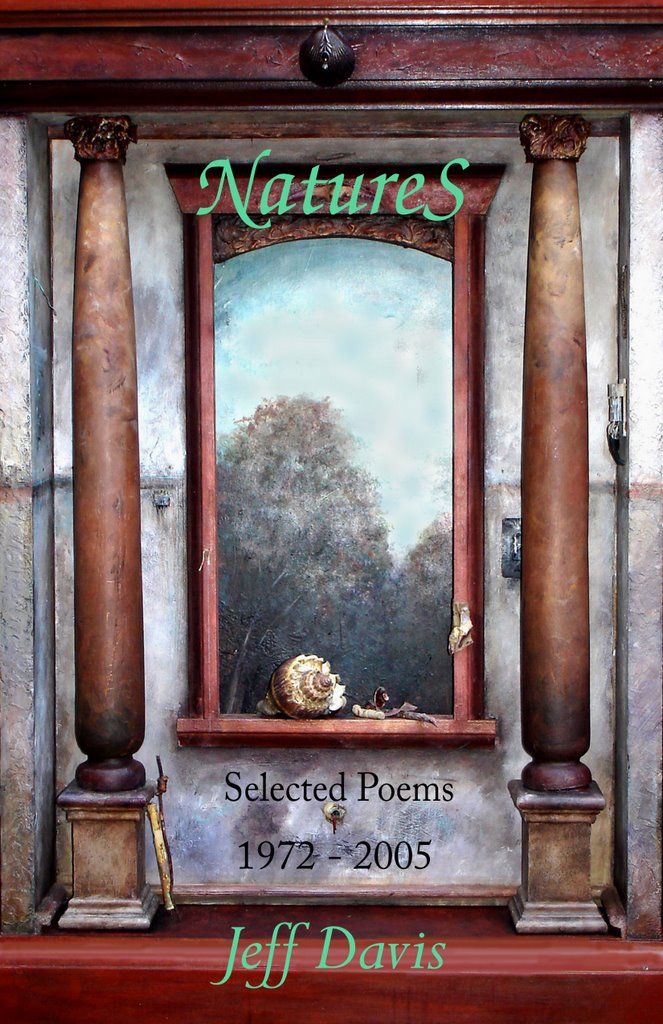
Not many things in life are free, but Bill Knott, one of the essential poets of the second half of the last century, is determined that his poems will be numbered among them. At his new art blog, he makes a simple offer:
The bookcovers posted below are from a series of one-of-a-kind books, which I'm printing/stapling/et cet—

if you have a poetry venue (a reading series/MFA program/etc) where you can hand out these books free to those who might want them,

please email me with your particulars,

and I'll send you a box of books to give away—

*
p.s. if you are one of my facebook "friends" and would like to receive free one or some of these books, message me with your request/postal address—
If you qualify, I'd take him up on it. It's a good excuse to join FaceBook, right? Not that you needed one; you're probably already there.

Back when Bill had a poetry blog, he posted links to downloadable versions of his current collections, which usually combined both new and old work in arrangements that bore little relationship to those in his more formally published actual, you know, books. They offered fascinating glimpses into the correspondences he saw within the body of his work. I'm sure these will, too.

Labels: ,

Monday, October 29, 2007

A new Bill Knott

Bill's got a new book, Cribsheets, up at his blog.

In it he finally republishes "(Sergey) (Yesenin) Speaking (Isadora) (Duncan)", one of my favorites from The Naomi Poems, his first book, and the new work seems strong and characteristically mercurial in the best sense - "fast as greased lightning", as my folks might have said.

Bill's barely mentioned the new collection, so it'd be easy to miss, even if his place is one of your regular stops. I haven't read through the whole thing yet (it's a hefty chapbook), but what I've read tells me it's worth delving into. Go and delve.

Labels: ,

Tuesday, August 07, 2007

Music and Mirror Neurons


As I mentioned below, some of my favorite blogs are actually science blogs - or, more specifically, anthropology blogs, like Archaeoblog; John Hawks Anthropology Weblog, which focuses
on paleoanthropology, genetics, and evolution; Dienekes Anthropology Blog (featuring at the moment a post on "Mating patterns amongst Siberian reindeer hunters" ; you know that's got to be good); and PZ Meyers' Pharyngula.

One of the places their links have often taken me is the online science mag, Seed, which a couple of months ago ran a fascinating interview between David Byrne, the lead singer and songwriter, as Seed says, "of the seminal late 70s band Talking Heads", and Daniel Levitin, "who worked as a session musician, sound and recording engineer, and record producer", but "is now the James McGill professor of behavioral neuroscience and music at McGill University, and the author of The New York Times bestseller This Is Your Brain on Music".

The interview explores different approaches to articulating the role music plays in consciousness, and its complex relationship to emotion (from, for once, the performer's standpoint):

DB: In a musical performance, whether it's recorded or live, people feel the emotion is coming from the performer, and that's what makes it authentic and true and therefore more upstanding and good. Whereas I would say, yeah, okay, a little bit. But music has attributes that you can objectify. This kind of sound, this kind of rhythm, will generate this kind of emotion even if it's done in a half-ass manner.

Anyone who's ever played air guitar should be interested in their exchange about that bit of human play:

One of the great mysteries in human behavior was that a newborn child can look up at its parent, and the parent smiles, and the newborn will smile. Well, how does it know how to do that? How does it know by looking at an upturned mouth what muscles it needs to move to make its own mouth turn up? How does it know that it's going to produce the same effect? There's a whole complicated chain of neuroscientific puzzles attached to this question.

DB: So when you watch a performance, sports for example, you're not only watching somebody else do it. In a neurological kind of way, you're experiencing it.

DL:Yeah, exactly. And when you see a musician, especially if you're a musician yourself--

DB: —air guitar.

DL: Air guitar, right! And you can't turn it off—it's without your conscious awareness. So mirror neurons seem to have played a very important role in the evolution of the species because we can learn by watching, rather than having to actually figure it out step-by-step.

DB: Yeah, and not only that. You also empathize, you feel what they're feeling.
That, of course, is what drives Bill Knott up the wall about music, its power to inspire empathy:

(that's why they invented music in the first place: to accompany murder)

(that's the purpose of music: to facilitate killing) . . .
(Can you tell from those notes that Bill doesn't particularly like music?)

I may have more about all this later, but just go read it; it's a conversation well worth dropping in on.

~~~~~~~~~~~~~~~~~~~~~~~~~~~

Later 8/7/07: Update: To be fair, do read Bill's comment here, too.

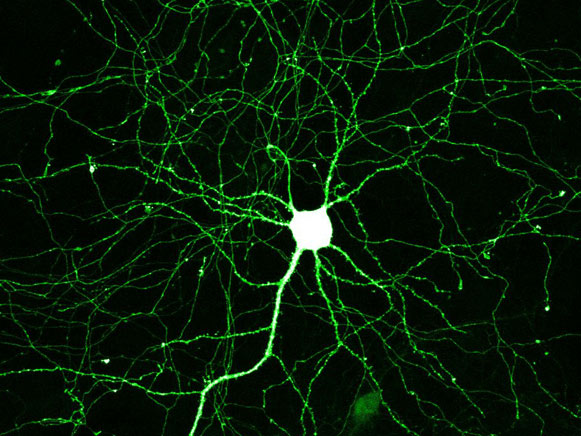
Thanks to Strangepaths.com for the neuron image, and a hat-tip to John Hawks Anthropology Weblog for the link.

Labels: , ,

Friday, April 13, 2007

Good Times in the Land of Knott

Earlier this year Bill Knott thought he might shut down his blog; he went so far as to delete many of the posts he'd put up (so some of the links in my earlier posts about him no longer work). He seems to have come to the realization, though, that killing the blog would have effectively left him silent, since he dislikes publishing otherwise, considers commercial book publishers vicious, etc. So he decided to keep on blogging.

He seems otherwise to be in a positive frame of mind these days. Where his blog previously used to lead with a compendium of negative reviews of his work and dismissive comments about him as a person and poet, he's now posted a gathering of the positive things reviewers and fellow poets have said about him over the years - things like

"[Bill] Knott was an incredibly important poet to me and still is; I think Bill Knott is a genius and probably the least known great poet in America. It's really kind of pathetic that he's not as well known as he was even thirty years ago because he's even better now."
—Thomas Lux, The Cortland Review (August 1999)

“Bill Knott is one of the best poets writing in America. Without question, he is the most original.”
—Kurt Brown, Harvard Review (Spring 1999)

"Bill Knott is a genius." —Tom Andrews, Ohio Review (1997)

“It is no accident that the major British and American poets of the 19th and 20th century were outsiders. . . . The most original poet of my generation, Bill Knott, is also the greatest outsider.”
—Stephen Dobyns, AWP Chronicle (1995)
And he's reposted much of his poetry - his Acting Poems, his Selected Love Poems, his Short Poems volumes One and Two, as well as worksheets for translations of Baudelaire and Montale. It's a trove of real value, some of the most distinctive poetry published in these states over the last forty years.

Having done a little translation myself, I'm fascinated by his worksheets for Montale and Baudelaire. In each, he provides a presumably provisional translation for the poem - here's Baudelaire via Knott

AFTER BAUDELAIRE'S CAUSERIE

The ocean of verse has left in my chest
That stale ebb-tail taste of a bile blueplate;
Its heft sits bitter against my lips' crest;
Even my critics' deaths can't renovate

An appetite for this: acid reflux
My poems have all become, which in their prime
Fed vanity's veins and guts with grubsex
Enough to inspire one more ex-lifetime . . .

My heart? Is Heartburnsville. Landfill palace
Leveled ever since my fellow poets
Chewed its dumpster pews into prose-pellets.

Come share their bard-fare, their warmth and fireplace—
Eyes blazing like a holiday barrage,
They char my offal flesh long past garbage.


Followed by the workings that led him to his draft:

Enough to inspire another lifetime . . . /
Or more to inspire at least one lifetime . . .

Come share the warmth of their bard-fare fireplace—

The ocean of verse has left in my chest
The stale, ebb-tail taste of a bile blueplate—
Heft to my lips it's kept its saltcrust crest—
Heft/Half to my lips it heaves its saltcurst crest—
Half to my lips it heaves its bitter crest—
Half to my lips it hoists its bitter crest—
regurgitate heartgorged
Half to my lips regurgitates its crest—

providing a wonderful glimpse into the process of creating translations (or transversions, as Knott calls them), the complex decisions a poet must make in an effort to convey an original text into his own alien tongue.

Go check it out. Now. After all, there's no telling when it might all disappear again.

Labels: ,

Sunday, August 27, 2006

Knotty Issues: A Note on Music and Poetry


Bill Knott made a remark in an interview early last year that made me just shake my head when I read it. He said he didn't like music. Wait, let him say it: "I don't like music; I try to listen to as little of it as possible. " Not only does he not like music, he seems to consider it almost evil:
The arrogance of composers and musicians is insufferable. They really believe Pater's dictum that all the other arts are inferior, that all the other arts "aspire towards the condition of music." But every military that ever marched out to murder rape and destroy was led by what art: were those armies fronted by poets extemporizing verse -- by sculptors squeezing clay -- by painters wielding brushes -- actors posing soliloquies? No, the art that led those killers forth, the art whose urgent strident rhythms stirred and spurred their corresponding bloodlust, was the art to which they felt closest, the art that mirrored their evil egos. That's why they have always put music up there at the vanguard of their war-ranks, because not only is it the emblem, the fore-thrust insignia of their purpose, it is their purpose: it is the condition to which they aspire.

Well ... sadly, language also has had some use in the cult of war. "Charge!" "Bombs away!" " Kill them all and let God sort 'em out." "The only good [fill in the blank] is a dead [fill in the blank]." come quickly to mind. Many a poem has been written to celebrate the deeds of men in war. Rejecting music because the agents of empires, nation states, city states, and tribes have used it, use it, to nefarious ends would be like rejecting language for the same reason. The only alternative is silence, because there's no form of human expression that's innocent in the way Knott wants music to be.

Poetry itself, of course, has it's own music. Ole Ezra (quaint as it might now be to mention) famously posited sound as one of the determinative dimensions of poetry: Melopoeia, Pound called it, going back to the Greek for his term, making-of-song, "wherein the words are charged ... with some musical property". The melo of the word, song, is close to mele, that ancient world's word for honey.

Though poetry is "the articulation of sound forms in time," to echo Susan Howe's still useful title, it's not "just" music - and a poetry that moves to the point of convergence with sound itself, it seems to me, loses many possibilities otherwise. Music may have some direct connection to our psyches and their (our) emotional states (most musicians I know believe that it does, and when I'm deep into the composition of a favorite composer or improvisational artist, I'd find it hard to argue otherwise), but language itself has its own deep roots in psyche, in thought and mind: indeed, it's mind's primary instrument of signification, the process of producing signs for - and of - the world. Language is what we use to describe and define the world and the activities of consciousness within it.That's why Pound also spoke of "Logopoeia," the making-of-logos, as one of poetry's other determinations. It's a complex thing, though, the logos. Here's Pound, from 1929:

Logopoeia, ‘the dance of the intellect among words’, that is to say, it employs words not only for their direct meaning, but it takes count in a special way of habits of usage, of the context we expect to find with the word.+ It holds the æsthetic content which is peculiarly the domain of verbal manifestation and can not possibly be contained in plastic or in music. *

Poetry is not just sound, but sound forms, and the difference between poetry and music is defined by the nature of the forms each creates. Poetry's are inextricably, ineluctably, if sometimes playfully, tied to the signifying nature of language. Slippery and problematic as it is (those features of articulation, as Pound implies, are just part of our material), its role in signification makes a crucial difference. Music's are not so tied.

Another part of a poem's meaning, though, is captured in the third of Pound's terms, "Phanopoeia," the-making-of-phanes (the root of our term "fantasy'), images. Often in a poem, the image, revealed in the structures of language available to the poet, is itself the logic of the poem, its logos. It's especially often true in short poems - like this one, from, who else, Bill Knott:

POEM TO POETRY

Poetry,
you are an electric,
a magic, field—like the space
between a sleepwalker's outheld arms!

That is an image!

For Howe and others, the word itself often becomes image, and is used as graphic form more than as lexical signifier. Certainly, poetry works to extend language from its lexical ground - or even, sometimes, to sing through contradiction, or self-refuting lexical propositions. Lots of "experimental" (isn't real poetry always experimental?) and post-avant work explores this territory. It's another strategy to get the intellect to dance among words.

Bill's sixty-six this year, 2006; he could be an older brother - one with demons of his own, no doubt, I'll never understand. I do hope some sweet sounds catch his ear before too long, or he might go through the rest of his life without the pleasure, the relief, the release of the spirit that music provides.

~~~~~~~~~~~~~~~~~~~~~~~~~~~~~~~~~~~~~~~~~~

* N.Y. Herald-Tribune 20 Jan. xi. 5/4, via the OED.

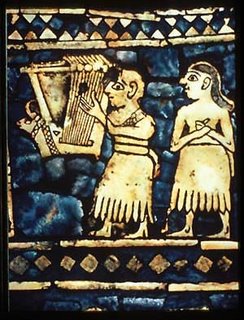
The image is Lyre Player and Singer, Ur, 4750 BC, from a piece now in the British Museum.

Labels: , ,

Friday, August 25, 2006

A Knotty Test

I may write the occasional 'Test of Translation' comparing English versions of texts from other languages, but Bill Knott ... well, no creature of half-measures, he provides every version he can find of Verlaine's "Claire de Lune":

CLAIR DE LUNE

Votre âme est un paysage choisi
Que vont charmant masques et bergamasques,
Jouant du luth, et dansant, et quasi
Tristes sous leurs déguisements fantasques.

Tout en chantant sur le mode mineur
L'amour vainqueur et la vie opportune,
Ils n'ont pas l'air de croire à leur bonheur
Et leur chanson se mêle au clair de lune,

Au calme clair de lune triste et beau,
Qui fait rêver les oiseaux dans les arbres
Et sangloter d'extase les jets d'eau,
Les grands jets d'eau sveltes parmi les marbres.


It's worth a look, of course - and his blog, sometimes exasperating, sometimes brilliant and insightful, is often worth more than a look. Knott's one of the true contrarians in the cosmos of poetry, orbitting at his very own unique angle to the ecliptic the work with language that's at the center of it all. (Or not.) And I've gotten so that I check his blog just about every day, in spite of my best intentions otherwise.

If you're not familiar with Knott's work, he's now published most of his poems in the archives of his blog, so you can get to know it right there.

Here's one of my favorites from his first book, published posthumously*, back when he was a virgin and a suicide; I don't believe he's seen fit to post it yet. Perhaps he's decided it's unworthy of further attention since his concerns as a poet have changed :

(Sergey) (Yesenin) Speaking (Isadora) (Duncan)

I love Russia; and Isadora in her dance.
When I put my arms around her, she's like
Wheat that sways in the very midst of a bloody battle,
-Un-hearkened to, but piling up peace for the earth
(Though my self-war juggles no nimbus) Earthquakes; shoulders
A-lit with birthdays of doves; piety of the unwashable
Creases in my mother's gaze and hands. Isadora "becalmed"
Isadora the ray sky one tastes on the skin of justborn babies
(Remember, Isadora
When you took me to America
I went, as one visits a grave, to
The place where Bill Knott would be born 20 years in the future
I embraced: the pastures, the abandoned quarry, where he would play
With children of your aura and my sapling eye
Where bees brought honey to dying flowers I sprinkled
Childhood upon the horizons, the cows
Who licked my heart like a block of salt) Isadora I write this poem
On my shroud, when my home-village walks out to harvest.
Bread weeps as you break it gently into years.
I still like the energy of the language as it shifts through boundaries of its syntax after line four, tumbling into an extraordinary paratactic cascade of images that drives the poem to the shift in the voice's tense at "(Remember, Isadora ..." , where it becomes not only a love poem but an elegy, a complex elegy for the childhood of Yesenin's fellow suicide, the poem's author; for Yesenin; for the love of Sergei Yesenin and Isadora Duncan; for the wheat that perishes into bread that sustains us all.

He has his moments, whatever he says.

See, too, if you're interested, this account of Knott as a teacher and mentor.


* The Naomi Poems/Corpse and Beans, by St. Geraud, 1940-1966 (Chicago, 1968), has on its back cover this author's statement: "Bill Knott (1940-1966) is a virgin and a suicide."

Labels: ,

Thursday, September 01, 2005

Posts in the Permanent Collection

Two posts archived here deal head-on with Robert Creeley's work:
Something Quite Different: A Farewell for Robert Creeley (published 2006), and
Robert Creeley: Here and Now (first published in 1979); they're the best place to start if you're interested in Creeley (or at least my engagement with his work).

In addition, a search of NatureS on "Robert Creeley" will turn up many other mentions of him, often in the context of discussions of Buffalo in the late nineteen sixties and early nineteen seventies, or considerations of other Black Mountain College poets.

Jonathan Williams was one of those Black Mountain College poets. He was born in Asheville, and lived much of his life about an hour and a half west of here, at Scaly Mountain. Posts on Jonathan include this appreciation of his work published just after his death in 2008; this post previews a showing of some of his photographic work; and another post provides production notes for the Wordplay show featuring Jonathan reading his work, live and in person, at Sylva's City Lights Books in 2005.

Articles on Thomas Meyer's 2006 translation of the daode jing can be found here, here, and here. Production notes for the Wordplay show that featured Tom reading his translation, as well as a selection of earlier work, will be found here, and the notes for the program featuring his reading of Kintsugi and other poems are here.

A Note on Jack Clarke discusses Charles Olson's Buffalo friend and fellow poet, who founded the Institute of Further Studies. There's look at some of Novalis' fragments here; the great German Romantic was among authors included in the Institute's unique Curriculum of the Soul.

I've discussed Bill Knott's poetry, as well as his aversion to music, several times - here and here and here, for instance.

Visual artist Joyce Blunk is featured in an article on her piece "Crown Conch"; there's also an interview with Joyce.

Guitarist Steve Kimock, a master of musical improvisation, is the subject of several posts, including this one and this one.

Wait, there's still more! Posts, for example, on Baby Beat Thomas Rain Crowe, and his group The Boatrockers, and poets Fred Chappell and Jim Applewhite.

Other possible attractions: a post on poetry and computers; another farewell, this one to west-coast surrealist poet Ken Wainio.

Over on Eden Hall, there are older posts about happenings at the Black Mountain College Museum + Arts Center, including one on Hazel Larsen Archer and the book about her work the Black Mountain College Museum + Arts Center published in 2006. There are several of her photos here.

Enjoy.

~~~~~~~~~~~~~~~~~~~~~~~~~

Updated 2/19/2009 to include additional posts.

Labels: , , , , , , , , , ,