Wednesday, April 23, 2008

Joyce Blunk: Collections and Scars


Like the rest of my Wordfest fellows, I'm covered up with final preparations for the festival. I wanted to take just a minute, though, to note an exhibit of some recent work by painter/sculptor Joyce Blunk. It's only up a few more days, through this Friday, but it's worth a special trip to the Ramsey Library at UNCA to see the small show (only sixteen pieces in all) that's hung there. It includes both some of her fabulous and distinctive constructions, her "boxes", and some new, very powerful paintings, including four luminous Scar paintings. Among the constructions, it even includes one of my old favorites, Deep Autumn Asheville, a photo of which served as one of the limenal images in NatureS.

In her artist's statement, Joyce discusses what she sees as the emotional resonances of the constructions, and articulates her concern that her work do what fully actualized art always does, embody and engender transformation:
Some of the boxes show my interest in introducing an element of deep space by incorporating the illusion of distant landscapes beyond a window. A contrast is created between the romantic beauty of the landscape and the starker reality of the interior. Most of these pieces show lush mountains at the changing of seasons and at a time of day when the light is moody and transitional. The predominant feeling for me is nostalgia, yearning, and great melancholy. In most of the boxes and mixed media paintings, ordinary items are transformed by being presented in a formal and ceremonious way that alters the viewer’s way of seeing.
May it be so.

~~~~~~~~~~~~~~~~~~~~~~~~~~~~~~~~

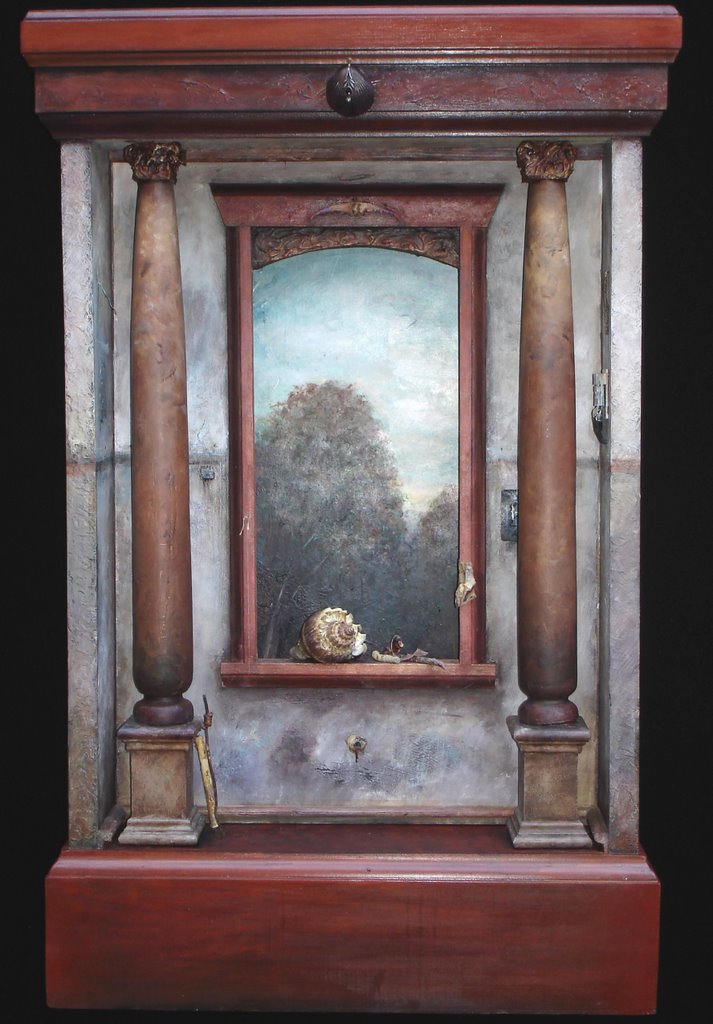
The image presents one of the new constructions, "Formal Collection".

Labels:

Wednesday, May 30, 2007

NatureS: Joyce Blunk's Constructions

One of the great pleasures of putting NatureS together was getting to know Joyce Blunk and her work. While photographs of five of her constructions do grace the text, four of them are monochrome and therefore don't really convey particularly well the impact of the pieces featured. To celebrate the book's anniversary, here they are in color. Click on the images for (much) larger versions.

To the left, "Crown Conch," a detail of which became the basis for the cover of the book. It includes among its materials wood, paint, metal, plastic, and shells. It measures 17x27x6 inches.


The construction that appears on page 1, titled "Locust Pavillion," consists of wood, paint, metal, shells, paper, and seed pods, and measures 15x31x5 inches.


The piece on page 23, titled "Weeping Garden," is made of wood, paint, shells, glass, cloth, pods, and metal, and measures 15x26x5 inches.


The piece on page 47, titled "Deep Autumn, Asheville," is built of wood, paint, metal, shells, seed pods, and string.


The piece on page 73, titled "Nothing Left," constructed of wood, paint, wire, bones, and a teabag, measures 12x20x4.5 inches.


And here's a detail of "Nothing Left", just to give a closer looks at its intricacies:


Thanks again to Joyce for sharing them.

Labels: ,

Sunday, April 02, 2006

NatureS: Joyce Blunk's "Crown Conch"

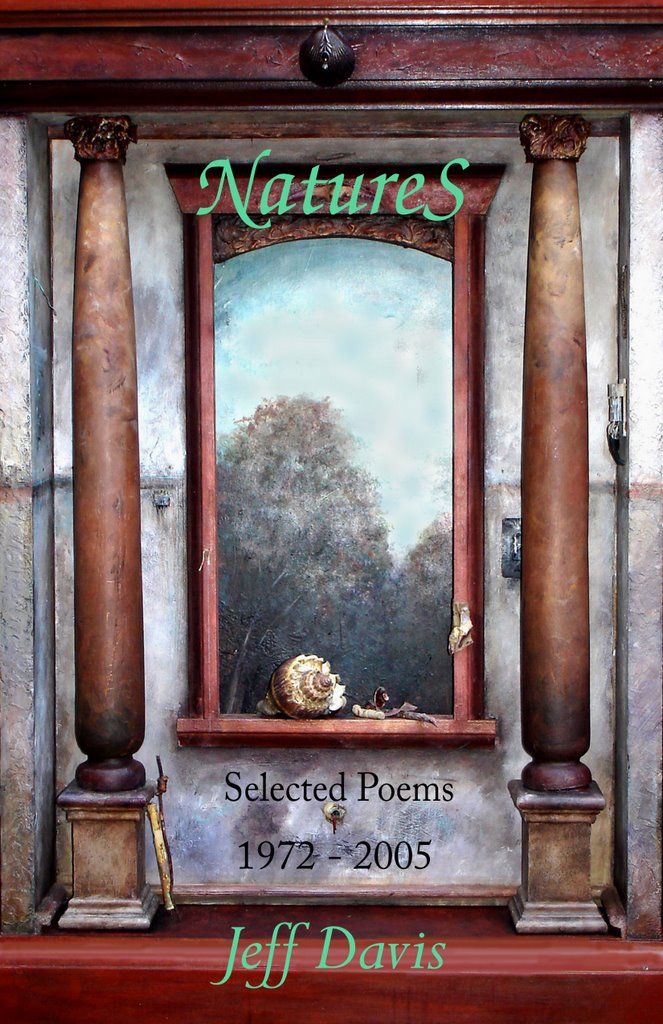
One of the pieces by Joyce Blunk that I found (and find) really involving, one that conjured up a world for me, she's named, for obvious reasons, "Crown Conch". It's central image and columnar frame will be featured on the cover of NatureS; the photo at left includes the whole contruction. A couple of weeks ago I asked her how she's gone about developing it.

Jeff: I am intrigued by your description of your work process, and your statement that “a particular object is usually the starting place.” Would it be reasonable to speculate that the conch is the starting place for “Crown Conch”? Clearly, a lot happened after it got started! And I could offer you a hundred questions about just that piece. But let me ask just one: What came next, after the conch?

Joyce: “Crown Conch” is a 1997 box and I was interested at that time, and still am, in constructions dealing with windowed interiors revealing an element of deep space by incorporating the illusion of distant landscapes. I was after a contrast created between the romantic beauty of the landscape and a starker reality of the interior. Most of these pieces show lush mountains at the changing of seasons and at a time of day when the light is moody and transitional. The predominant feeling, for me, is nostalgia, yearning, and a great melancholy. The shell, in this case, was added to the box when I had nearly finished. It seemed to really fit, and I liked the idea of the conch being isolated and removed from its origin. The shell is transformed by being presented in a formal and ceremonious way, altering the viewer’s way of seeing it.

After “Crown Conch” I did a box with a closed-in interior, a porch or vestibule, and an Egyptian theme. As you know from your own work, early ideas pop up in new ways again and much later. “The Egyptian Fish” revisits the subject of trophies, those display objects that symbolize personal superiority, prowess, and victory. In this instance, the “trophy” started out as a fish skeleton some German friends found in Egypt and sent to me. Collected and enshrined objects are at the forefront of all the trophy-theme pieces, but not far away there is always evidence of struggle and emotional expenditure. An important aspect is that the tallying up and showing forth always associated with trophies take place in a relentless state of deterioration and change, so that the pride in accomplishment is eroded by an ironic sense of futility.
It might have been a reasonable speculation on my part, but "Crown Conch", as Joyce says, didn't begin with the conch at all. It seems to have begun, instead, with the contrast between interior and exterior, and the sense of loss and dubious consolation implicit in the terms of that contrast for her.

Joyce will be showing "Crown Conch" and several other of her constructions on April 28th, for the publication party for NatureS at the Black Mountain College Museum + Arts Center . The book, after three sets of proofs, is now in the press, and should ship literally any day. More information on the festivities in the days ahead.

********************************

The photo of "Crown Conch" is by Joyce Blunk.


Original content © 2006.

Labels: ,

Thursday, March 16, 2006

NatureS: An Interview with Joyce Blunk

One of the great pleasures of putting together NatureS has been getting to know the work of Joyce Blunk. I didn’t know Joyce or her work at all when I started digging through files and notebooks for the poems that have come to constitute the book; Thomas Rain Crowe, who’d taken on the task of editing and publishing it for his New Native Press, knew us both, thought our work shared a form of relationship to the natural world, and eventually, gradually, introduced us to one another. He first published work by both of us as guest-editor for issue 2.2 of the online journal Nantahala Review; later, he brought over some slides and prints of Joyce’s work, while sharing with her some of the poems I was passing along to him for the book. Both Joyce and I, I believe, felt the mutual resonance that he’d sensed. It’s been almost a year ago, now, since the afternoon Thomas and I finally drove over to Joyce’s house, and she and I actually met. She was kind enough to take us up to her attic studio and show the collection of objects stored there, waiting till they should find their way into a work – a full human skeleton (what better reminder of mortality?), boxes of locust shells, fibrous bits of palm trunk, lustrous seed pods of various plants, feathers, boxes of magical objects of all sorts. Several of the wonderful constructions I’d admired in photographs were stored there as well, between shows, and so I got to spend some time actually before them, rapt, entranced by their details and the stories at which they hinted.

Joyce, in time, generously allowed us to use photographs of five of these constructions for the book, one for the cover, and four for section title pages. As many times as I’ve seen them now, as the book prepares to go through the press, it’s still a profound pleasure to come across them, and always worth a few moments to look at them yet again, and see what they disclose anew. I’m honored and delighted that they’re there.

Earlier this year I asked Joyce some questions about her life and work. Here’s some of the interview:

Jeff: So…. You grew up in Iowa, I remember, and got your degree at the university there. Were you painting then? Who were important artists for you?

Joyce: Yes, I was born in Iowa and grew up there. My parents and brothers and I lived in Fort Dodge, a medium-sized town, but I often spent summers—especially in grade school and junior high—at my grandmother’s farm. I knew as a kid that I wanted to be an artist. After high school, I went to the university in Iowa City and majored in art. When I graduated I taught for a few years, and then went back to Iowa City for the MFA degree. Yes, I was a painter, and still am. My graduate degree is in painting. But while I was in graduate school I took a multimedia course taught by Hans Breder. It was there that I really began exploring the infinite possibilities of combining any and all materials to create art. I started looking at the work of Lucas Samarias, Robert Rauschenberg, Louise Nevelson, Lee Bontecou, the French artist Arman, George Segal, Edward Kienholz, Daniel Spoerri. And Antoni Tapies, that guy—his work is just so thrilling. Recently I’ve been so moved by the work of the contemporary Spanish artist Carmen Calvo. I saw a large show of hers a few years back in Salzburg, Austria, and I just haven’t been the same since. Then the exciting epoxy sculptures of Frank Gallo, who also attended the University of Iowa. Every day I’d walk past several of his sculptures placed out in the hallways of the art department. And of course the extraordinary boxes of Joseph Cornell have also impressed me. I can remember seeing an exhibit of his at the Museum of Modern Art in New York. I went in at opening time and was shocked to see it was dark outside when I left. As far as painting goes, I look at everything. I’ve always loved the slightly edgy work of Richard Lindner and George Tooker, the formality and content of Edward Hopper, and the incredible tonality of Georgio Morandi.

Jeff: How did you begin to create your constructions? When you work on a painting or a construction, is there a narrative, a story that invents itself about or around the piece as you work? Or are you just working in a disciplined, deliberate way on the visual level?

Joyce: Since childhood, I’ve painted and collected objects, and I guess it was inevitable that the two eventually came together in my work. I’ve just always collected found objects, both natural and manmade, that are interesting to me in any way—texture, symbolic meaning, state of decrepitude, color, shape. In graduate school these objects became more important to me as directly related to my work, and I started actually putting them into or onto paintings to create 3-D assemblages. Sometimes these sculptural collages were arranged on wooden-panel paintings, sometimes they were vacuum-formed under a clear plastic covering, and sometimes I arranged them inside wooden boxes or on shelves that I built. As I work, a particular object is usually the starting place. I start with some “thing” that is interesting to me, an object that generates ideas and reactions from me, and then create a setting for the object that will enable me to visually present those ideas and feelings. The content (or what you call “narrative”) of the piece emerges from building layer upon layer of paint, color, and textures and from the formal presentation of the object. On a visual level, I do work in a deliberate manner, but of course as I progress new images and ideas reveal themselves, so that the finished work is often quite a departure from what I had in mind when I started out. I have to just pretty much let the work go where it wants to, let it tell me what it is supposed to be rather than trying to confine it to some preset plan. I think most artists work that way, whether they are writers or visual artists or musicians or whatever. That’s exactly what the contemporary American visual artist Richard Tuttle was talking about when he said, “If I can free a humble material from itself, perhaps I can free myself from myself…. I think [my work] knows, is smarter than I am, better than I am.” I believe my work is beyond me. You plan a certain amount, and then it becomes both an intuitive thing and a thought-out process that used your skills to take it to its own destination.

Jeff: Are you traveling again soon? What is there about travel that is good for you?

Joyce: For the most part, my working time is spent alone in my studio, so I find it very important to get out and meet other professional artists. Art residencies are a wonderful way to have intensive studio time and to share ideas with others. I’ve been fortunate enough to receive fellowships for foreign residencies as well as American ones, and each has been a great enrichment. The next thing on my schedule is a residency at No Boundaries International Art Colony on Bald Head Island off the coast of North Carolina this November, and further on down the line I have been accepted for another residency, for the month of May, 2008, at Cill Rialaig International Artists’ Retreat in Ireland. I have especially loved the opportunity of working abroad, meeting foreign artists, seeing some great museums in those places, and I have produced some of my best work there. I have remained in touch with many writers and visual artists that I’ve met over the years at artist retreats here in the US and in Europe. Living and working in a place so different from my own studio is a real charge, it’s just so stimulating and does such a lot for me. Last spring I spent almost two months on a residency in this very small Mediterranean fishing village in the far northeast part of Spain. Being in a new place, especially in a foreign country, is always so enlivening. To work that intensely for a long period is a great experience. Then, at the end of the time in Spain, I rented a car for a week and drove through the Pyrenees—it was bliss. I love the excitement and provocation I feel in other cultures—even just the distinctive foreign shape of a door handle or a telephone. And of course the landscapes…. And the textures, my God—things are as old as time. And, you know, all that is bound to influence my work in a new way. Throw in all that, and meeting a lot of new people, and the effect can be life-long. And, if you do good work, a long time after that because the work lives on its own.


Joyce’s work will be part of the publication celebration for NatureS on April 28th (more about that soon), and she currently has work in a juried group exhibition, “Discovering Contemporary Art in the Carolinas”, at the Fayetteville Museum of Art; it runs from March 19 to May 7, 2006. Then, May 26 through July 9, 2006, the National Association of Women Artists will include her work in their group show at the Goggle Works Center for the Arts in Reading, Pennsylvania. She has solo shows coming up at Rockford College in Rockford, Illinois, in 2007, and is in the planning stage for show at Radford University in Radford, Virginia, in 2008. Keep an eye open.

********************************

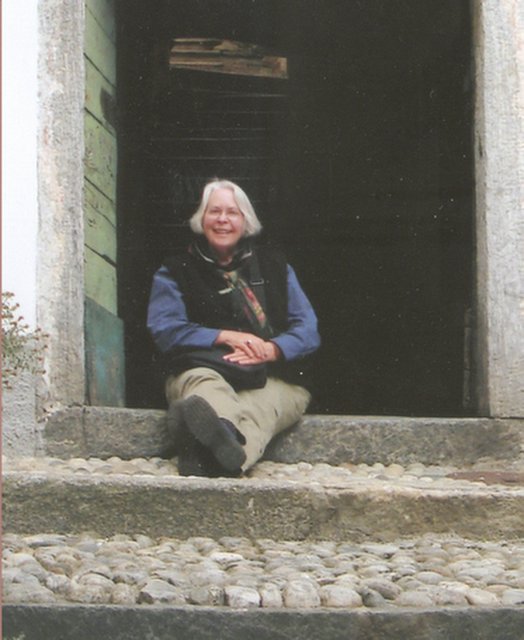
Note: The photo is of Joyce in Switzerland, October, 2005.
Original content © 2006.

Labels: , ,

Thursday, September 01, 2005

Posts in the Permanent Collection

Two posts archived here deal head-on with Robert Creeley's work:
Something Quite Different: A Farewell for Robert Creeley (published 2006), and
Robert Creeley: Here and Now (first published in 1979); they're the best place to start if you're interested in Creeley (or at least my engagement with his work).

In addition, a search of NatureS on "Robert Creeley" will turn up many other mentions of him, often in the context of discussions of Buffalo in the late nineteen sixties and early nineteen seventies, or considerations of other Black Mountain College poets.

Jonathan Williams was one of those Black Mountain College poets. He was born in Asheville, and lived much of his life about an hour and a half west of here, at Scaly Mountain. Posts on Jonathan include this appreciation of his work published just after his death in 2008; this post previews a showing of some of his photographic work; and another post provides production notes for the Wordplay show featuring Jonathan reading his work, live and in person, at Sylva's City Lights Books in 2005.

Articles on Thomas Meyer's 2006 translation of the daode jing can be found here, here, and here. Production notes for the Wordplay show that featured Tom reading his translation, as well as a selection of earlier work, will be found here, and the notes for the program featuring his reading of Kintsugi and other poems are here.

A Note on Jack Clarke discusses Charles Olson's Buffalo friend and fellow poet, who founded the Institute of Further Studies. There's look at some of Novalis' fragments here; the great German Romantic was among authors included in the Institute's unique Curriculum of the Soul.

I've discussed Bill Knott's poetry, as well as his aversion to music, several times - here and here and here, for instance.

Visual artist Joyce Blunk is featured in an article on her piece "Crown Conch"; there's also an interview with Joyce.

Guitarist Steve Kimock, a master of musical improvisation, is the subject of several posts, including this one and this one.

Wait, there's still more! Posts, for example, on Baby Beat Thomas Rain Crowe, and his group The Boatrockers, and poets Fred Chappell and Jim Applewhite.

Other possible attractions: a post on poetry and computers; another farewell, this one to west-coast surrealist poet Ken Wainio.

Over on Eden Hall, there are older posts about happenings at the Black Mountain College Museum + Arts Center, including one on Hazel Larsen Archer and the book about her work the Black Mountain College Museum + Arts Center published in 2006. There are several of her photos here.

Enjoy.

~~~~~~~~~~~~~~~~~~~~~~~~~

Updated 2/19/2009 to include additional posts.

Labels: , , , , , , , , , ,